
Textbook Question
What does the cuticle do?
What do stomata do?
Predict how the thickness of the cuticle and the number of stomata differ in plants from wet habitats versus dry habitats.
 Verified step by step guidance
 05:46
05:46
 07:55
07:55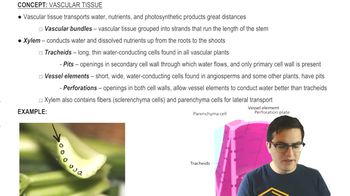 06:58
06:58What does the cuticle do?
What do stomata do?
Predict how the thickness of the cuticle and the number of stomata differ in plants from wet habitats versus dry habitats.
You attached a birdfeeder to a tree 5 years ago at a position 6 feet above the ground. The tree has grown since at a rate of 1 foot per year. What is the current height of the birdfeeder?
Explain why continuous growth enhances the phenomenon known as phenotypic plasticity.
Which statement best characterizes secondary growth?
a. It results from cell divisions in the vascular and cork cambia.
b. It increases the length of the plant stem.
c. It results from divisions in the apical meristem cells.
d. It often produces phloem cells to the inside and xylem cells to the outside of the vascular cambium.
Which statement best characterizes primary growth?
a. It does not occur in roots, only in shoots.
b. It leads to the development of cork tissue.
c. It produces the dermal, ground, and vascular tissues.
d. It produces rings of xylem, phloem, and cork tissue.
Evaluate the following statements regarding tracheids and vessel elements.
Select True or False for each statement.
T/F Both tracheids and vessel elements are specialized for water conduction.
T/F Both tracheids and vessel elements have pits.
T/F Vessel elements have perforation plates but tracheids do not.
T/F Tracheids and vessel elements have to be alive in order to transport water.