Evaluate this statement: Evolution is said to occur when new traits accumulate over time, increasing complexity.
Ch. 31 - Protostome Animals
Chapter 31, Problem 6
Use your understanding of insect evolution to predict two adaptations for terrestrial living that occurred in spiders.
Verified step by step guidance1
Step 1: Understand the question. The question is asking for two adaptations that spiders, as terrestrial insects, have developed over the course of their evolution.
Step 2: Recall the characteristics of terrestrial living. Terrestrial living involves survival on land, which presents challenges such as the need for structural support, the need to avoid desiccation, and the need to capture or find food.
Step 3: Identify the first adaptation. One adaptation that spiders have developed is the ability to produce silk. This adaptation allows spiders to create webs, which they use to capture prey, thus solving the problem of finding food on land.
Step 4: Identify the second adaptation. Another adaptation that spiders have developed is the evolution of book lungs. Book lungs are respiratory organs that allow spiders to breathe air, which is necessary for terrestrial living.
Step 5: Summarize the adaptations. So, the two adaptations for terrestrial living that occurred in spiders are the ability to produce silk for capturing prey and the evolution of book lungs for breathing air.

Verified video answer for a similar problem:
This video solution was recommended by our tutors as helpful for the problem above.
Video duration:
1mWas this helpful?
Key Concepts
Here are the essential concepts you must grasp in order to answer the question correctly.
Evolutionary Adaptations
Evolutionary adaptations are traits that have developed in organisms over time through the process of natural selection. These adaptations enhance an organism's ability to survive and reproduce in its environment. In the context of spiders, adaptations for terrestrial living may include changes in respiratory systems and locomotion to better navigate land habitats.
Recommended video:
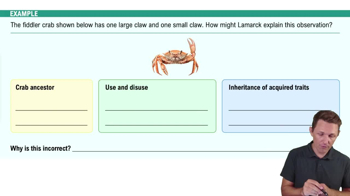
History of Evolutionary Theory Example 1
Respiratory Systems in Terrestrial Organisms
Terrestrial organisms require efficient respiratory systems to extract oxygen from the air. Spiders, which are arachnids, have adapted by developing book lungs or tracheae, allowing them to breathe air effectively. This adaptation is crucial for their survival on land, as it enables them to thrive in various terrestrial environments.
Recommended video:
Guided course
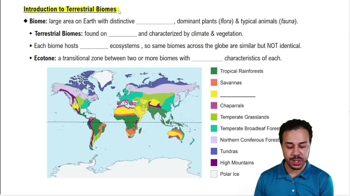
Introduction to Terrestrial Biomes
Locomotion and Silk Production
Locomotion in spiders has evolved to facilitate movement across diverse terrestrial landscapes. Spiders utilize their eight legs for walking and climbing, while silk production allows them to create webs for trapping prey and providing shelter. These adaptations not only enhance their mobility but also improve their hunting strategies and reproductive success in terrestrial habitats.
Recommended video:
Guided course
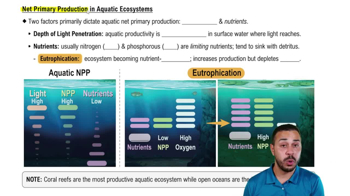
Primary Production in Aquatic Ecosystems
Related Practice
Textbook Question
1
views
Textbook Question
Pose a hypothesis to explain why the evolution of the wing was such an important event in the evolution of insects.
Textbook Question
Which of these choices is an example of homology (similarity due to common ancestry)?
a. Suspension feeding in sponges and clams
b. Ectoparasite lifestyle in aphids and ticks
c. Cnidocytes (stinging cells) in jellyfish and sea anemones
d. Radial symmetry in cnidarians and echinoderms
1
views
Textbook Question
Which protostome phyla successfully made the transition from water to land? Select True or False for each phylum.
T/FMollusca
T/FArthropoda
T/FAnnelida
T/FNematoda
Textbook Question
Propose an explanation for why annelids and arthropods were thought to be closely related, before phylogenetic analyses in the late 1990s.
1
views