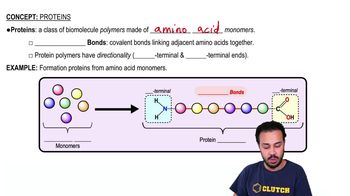
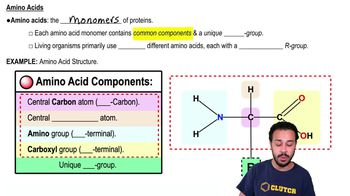
Make a concept map that relates the four levels of protein structure and shows how they can contribute to the formation of hemoglobin. Your map should include the following boxed terms: Primary structure, Secondary structure, Tertiary structure, Quaternary structure, Amino acid sequence, R-groups, αα-helices, and ββ-pleated sheets.
Why are proteins not considered to be a good candidate for the first living molecule?
a. Their catalytic capability is not sufficient for most biological reactions.
b. Their amino acid monomers were not likely present in the prebiotic soup.
c. They cannot serve as a template for replication.
d. They could not have polymerized from amino acid monomers under early Earth conditions.
Verified step by step guidance
Verified video answer for a similar problem:
Key Concepts
Catalytic Capability of Proteins
Amino Acid Availability in Prebiotic Soup
Template for Replication
Based on what you know of the peptide bonds that link together amino acid residues, why would proline's side chain reduce the flexibility of the backbone?
If a cell were to use only 10 of the 20 possible amino acids, how much effect would you expect this to have on protein diversity? Calculate and compare the number of different sequences that can be generated by randomly assembling either 10 or 20 amino acids into peptides that are five residues long.
Explain how molecular chaperones facilitate protein folding in many different polypeptides, each with their own specific shape.
Which of the following correctly describe an active site? Select True or False for each statement.
T/F It is the location in an enzyme where substrates bind.
T/F It is the place where a molecule or ion binds to an inactive enzyme to induce a shape change to make it active.
T/F It is the portion of an enzyme where chaperones bind to help enzymes fold.
T/F It is the site on an enzyme where catalysis occurs.
Predict the effect on protein function if each polypeptide adopted only a single, inflexible shape based on its primary structure.
