Angiosperms such as grasses, oaks, and maples are wind pollinated. The ancestors of these subgroups were probably pollinated by insects, however. As an adaptive advantage, why might a species 'revert' to wind pollination? (Hint: Think about the costs and benefits of being pollinated by insects versus wind.) Why is it logical to observe that wind-pollinated species usually grow in dense stands containing many individuals of the same species? Why is it logical to observe that in wind-pollinated deciduous trees, flowers form very early in spring—before leaves form?
Soils, water, and the atmosphere are major components of the abiotic (nonliving) environment. Describe how green plants affect the abiotic environment in ways that are advantageous to humans.
Verified step by step guidance
Verified video answer for a similar problem:
Key Concepts
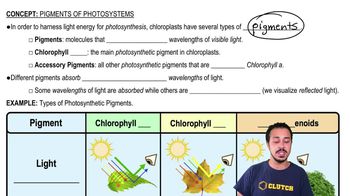
Photosynthesis
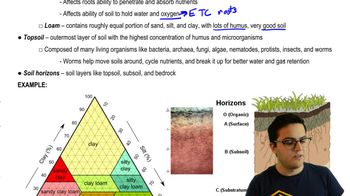
Soil Formation and Health
Water Cycle Regulation
What does it mean to say that a life cycle is gametophyte dominant versus sporophyte dominant?
The evolution of cuticle presented plants with a challenge that threatened their ability to live on land. Describe this challenge, and explain why stomata represent a solution. Compare and contrast stomata with the pores found in liverworts.
What is a pollen grain?
a. sperm-producing gametophyte
b. egg-producing gametophyte
c. sperm-producing sporophyte
d. sperm
Explain the difference between homosporous and heterosporous plants. Where are the microsporangium and megasporangium found in a tulip? What happens to the spores that are produced by these structures?
Evaluate the following statements regarding seeds. Select True or False for each statement.
T/FThey contain an embryo.
T/FThey contain nutritive tissue for the embryo.
T/FThey consist entirely of diploid cells.
T/FThey are also referred to as spores.
