Unlike plant cell walls that contain cellulose, bacterial cell walls are composed of ___________.
Ch. 26 - Bacteria and Archaea
Chapter 26, Problem 1
What do some photosynthetic bacteria use as a source of electrons instead of water?
a. Oxygen (O2)
b. Hydrogen sulfide (H2S)
c. Organic compounds (e.g., CH3COO−)
d. Nitrate (NO3-)
Verified step by step guidance1
Understand that photosynthesis involves the transfer of electrons to convert light energy into chemical energy. In plants, water (H2O) is typically the electron donor.
Recognize that some photosynthetic bacteria do not use water as their electron source. Instead, they use other compounds to fulfill this role.
Consider the options given: oxygen (O2), hydrogen sulfide (H2S), organic compounds (e.g., CH3COO−), and nitrate (NO3-).
Recall that certain photosynthetic bacteria, such as purple sulfur bacteria, use hydrogen sulfide (H2S) as an electron donor instead of water.
Conclude that hydrogen sulfide (H2S) is the correct answer, as it is commonly used by some photosynthetic bacteria as a source of electrons.

Verified video answer for a similar problem:
This video solution was recommended by our tutors as helpful for the problem above.
Video duration:
2mWas this helpful?
Key Concepts
Here are the essential concepts you must grasp in order to answer the question correctly.
Photosynthesis in Bacteria
Photosynthesis in bacteria differs from that in plants, as some bacteria do not use water as an electron source. Instead, they utilize other compounds, allowing them to thrive in environments where water is scarce or where other electron donors are more abundant. This adaptation is crucial for their survival and ecological role.
Recommended video:
Guided course
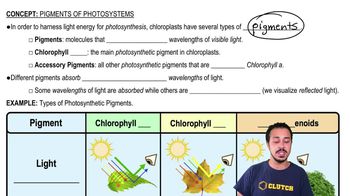
Pigments of Photosynthesis
Electron Donors in Photosynthesis
Electron donors are substances that provide electrons for the photosynthetic process. In some photosynthetic bacteria, compounds like hydrogen sulfide (H2S) or organic compounds are used instead of water. These alternative electron donors are essential for the bacteria's energy production and influence their habitat preferences.
Recommended video:
Guided course
Pigments of Photosynthesis
Hydrogen Sulfide as an Electron Source
Hydrogen sulfide (H2S) is a common electron donor for certain photosynthetic bacteria, particularly those found in sulfur-rich environments. These bacteria oxidize H2S to obtain electrons, which are then used in their photosynthetic processes. This ability allows them to occupy ecological niches where other organisms might not survive.
Recommended video:
Guided course
Hydrogen Bonding
Related Practice
Textbook Question
1
views
Textbook Question
Evaluate these statements about Koch's postulates, which are used to establish a causative link between a specific microbe and a specific disease. Select True or False for each statement.
T/FThe microbe must be present in individuals suffering from the disease and absent from healthy individuals.
T/FThe microbe must be isolated and grown in pure culture.
T/FIf organisms from the pure culture are injected into a healthy experimental animal, the disease symptoms should appear.
T/FThe microbe does not have to be isolated from the experimental animal as long as the disease is present.
Textbook Question
What are organisms called that use inorganic compounds as electron donors in cellular respiration?
a. Phototrophs
b. Heterotrophs
c. Organotrophs
d. Lithotrophs