
Consider the reaction between carbon dioxide and water to form carbonic acid: CO2(g)+H2O(l)⇌CH2O3(aq) In the ocean, carbonic acid immediately dissociates to form a proton and bicarbonate ion, as follows: CH2O3(aq)+H+(aq)⇌CHO3−(aq) If an underwater volcano bubbled additional CO2 into the ocean, would this sequence of reactions be driven to the left or the right? How would this affect the pH of the ocean?
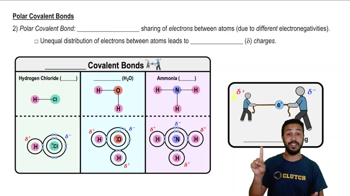
Which of these molecules would you predict to have the largest number of polar covalent bonds based on their molecular formulas?
a. C2H6O(ethanol)
b. C2H6(ethane)
c. C2H4O2(acetic acid)
d. C3H8O (propanol)
Verified step by step guidance
Verified video answer for a similar problem:
Key Concepts
Polar Covalent Bonds
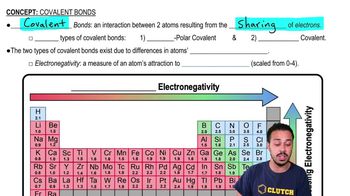
Electronegativity
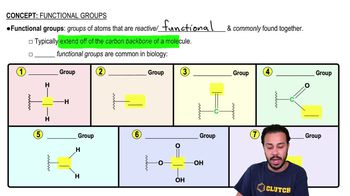
Molecular Structure and Functional Groups
What are the defining characteristics of a condensation reaction?
a. Two monomers are covalently bonded together and a water molecule is produced.
b. Two monomers are covalently bonded together and a water molecule is used up.
c. A polymer is broken down into monomers and a water molecule is produced.
d. A polymer is broken down into monomers and a water molecule is used up.
What factors determine whether a chemical reaction is spontaneous or not?
Which of these functional groups is known to be used for storing large amounts of chemical energy?
a. Amino group
b. Carbonyl group
c. Phosphate group
d. Sulfhydryl group
If you were given a solution that has a pH of 8.5, what would be its concentration of protons? What is the difference in proton concentration between this solution and one that has a pH of 7?
Locate fluorine (F) on the partial periodic table provided in Figure 2.2. Predict its relative electronegativity compared to hydrogen, sodium, and oxygen. State the number and type of bond(s) you expect it would form if it reacted with sodium (Na).
