
Textbook Question
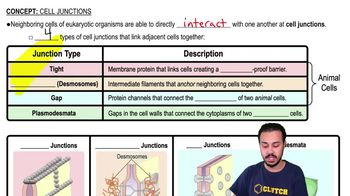
Summarize the experimental evidence in sponges showing that animal cells adhere to each other selectively. Explain the molecular basis of selective adhesion.
 Verified step by step guidance
 02:28
02:28
 05:33 05:33
Summarize the experimental evidence in sponges showing that animal cells adhere to each other selectively. Explain the molecular basis of selective adhesion.
Where are protein components of the extracellular matrix synthesized?
a. In the rough ER
b. In the Golgi apparatus
c. In the plasma membrane
d. In the extracellular layer itself
What does it mean to say that a signal is transduced?
a. The signaling molecule enters the cell directly and elicits a cellular response.
b. The signal is generated by the production of proteins.
c. The physical form of the signal changes between the outside of the cell and the inside.
d. The signal is amplified.
How do the extracellular filaments in plants differ from those in animals?
a. Plant filaments resist compression forces; animal filaments resist pulling forces.
b. Animal filaments consist of proteins; plant filaments consist of polysaccharides.
c. Plant extracellular filaments never move; animal filaments can slide past one another.
d. Plant filaments run parallel to one another; animal filaments crisscross.