
Textbook Question
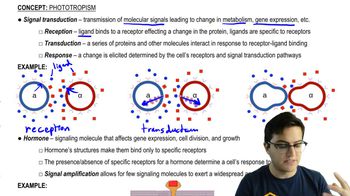
Steroid hormones, like most lipid-soluble signaling molecules, are processed directly. How does the absence of a signal transduction cascade in the processing of steroid hormones affect (b) signal regulation?
 Verified step by step guidance
 06:56
06:56
 04:25
04:25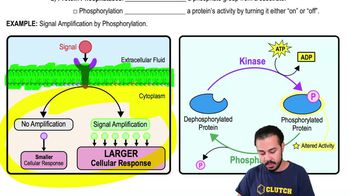 06:10
06:10Steroid hormones, like most lipid-soluble signaling molecules, are processed directly. How does the absence of a signal transduction cascade in the processing of steroid hormones affect (b) signal regulation?
Steroid hormones, like most lipid-soluble signaling molecules, are processed directly. How does the absence of a signal transduction cascade in the processing of steroid hormones affect (a) signal amplification?
Summarize the experimental evidence in sponges showing that animal cells adhere to each other selectively. Explain the molecular basis of selective adhesion.
Suppose you were to model amplification by the phosphorylation cascade in Figure 11.16, using a penny for each kinase 1, a nickel for each kinase 2, and a dime for each kinase 3. Also suppose that Ras and each of the kinases can activate 10 proteins. How much money would you need to construct your model?
Steroid hormones, like most lipid-soluble signaling molecules, are processed directly. How does the absence of a signal transduction cascade in the processing of steroid hormones affect (c) the cellular response that is possible?
How do the extracellular filaments in plants differ from those in animals?
a. Plant filaments resist compression forces; animal filaments resist pulling forces.
b. Animal filaments consist of proteins; plant filaments consist of polysaccharides.
c. Plant extracellular filaments never move; animal filaments can slide past one another.
d. Plant filaments run parallel to one another; animal filaments crisscross.