At what point in photosynthesis is the electromagnetic energy of light first converted into chemical energy?
Ch. 10 - Photosynthesis
Chapter 10, Problem 3
What is the role of PEP carboxylase in C4 and CAM plants?
a. It fixes CO2 into an organic acid.
b. It produces ATP for the Calvin cycle.
c. It replaces rubicso in the Calvin cycle.
d. It releases CO2 from organic acids.
Verified step by step guidance1
Understand the context: C4 and CAM plants have adapted to hot and dry environments by modifying their photosynthetic processes to minimize water loss and photorespiration.
Identify the role of PEP carboxylase: In both C4 and CAM plants, PEP carboxylase is an enzyme that plays a crucial role in the initial steps of carbon fixation.
Explain the function of PEP carboxylase: This enzyme catalyzes the addition of CO2 to phosphoenolpyruvate (PEP) to form oxaloacetate, a four-carbon compound, which is then converted into malate or other organic acids.
Clarify the significance: By fixing CO2 into organic acids, PEP carboxylase helps concentrate CO2 around the enzyme Rubisco, reducing photorespiration and increasing the efficiency of photosynthesis.
Conclude with the correct option: Based on the role of PEP carboxylase, the correct answer is option a: It fixes CO2 into an organic acid.

Verified video answer for a similar problem:
This video solution was recommended by our tutors as helpful for the problem above.
Video duration:
4mWas this helpful?
Key Concepts
Here are the essential concepts you must grasp in order to answer the question correctly.
PEP Carboxylase
PEP carboxylase is an enzyme that catalyzes the fixation of carbon dioxide (CO2) into a four-carbon compound, oxaloacetate, in C4 and CAM plants. This process occurs in the mesophyll cells and is crucial for capturing CO2 efficiently, especially under conditions where rubisco is less effective, such as high oxygen concentrations or low CO2 levels.
C4 Photosynthesis
C4 photosynthesis is a pathway that some plants use to efficiently fix CO2 in hot and dry environments. It involves the initial fixation of CO2 by PEP carboxylase into a four-carbon compound, which is then transported to bundle-sheath cells where CO2 is released for use in the Calvin cycle. This mechanism minimizes photorespiration and increases water-use efficiency.
Recommended video:
Guided course
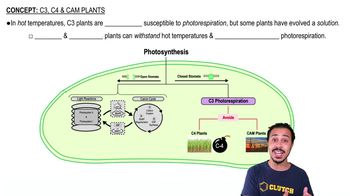
C3, C4 & CAM Plants
CAM Photosynthesis
CAM (Crassulacean Acid Metabolism) photosynthesis is an adaptation in some plants to arid conditions, allowing them to fix CO2 at night when stomata are open. PEP carboxylase fixes CO2 into organic acids, which are stored in vacuoles. During the day, CO2 is released from these acids for use in the Calvin cycle, reducing water loss by keeping stomata closed during the hottest part of the day.
Recommended video:
Guided course
C3, C4 & CAM Plants
Related Practice
Textbook Question
3
views
Textbook Question
Why is chlorophyll green?
a. It absorbs all wavelengths in the visible spectrum.
b. It absorbs wavelengths only in the red portions of the spectrum (680–700 nm).
c. It absorbs wavelengths only in the blue part of the visible spectrum (450–480 nm).
d. It absorbs wavelengths in only the blue and red parts of the visible spectrum.
Textbook Question
How is energy transferred among antenna pigment molecules?
a. By heat
b. By redox reactions
c. By fluorescence
d. By resonance
Textbook Question
Why is the chlorophyll in chloroplasts less likely to produce fluorescence compared to extracted chlorophyll molecules?
Textbook Question
Describe the three phases of the Calvin cycle and how the products of the light-capturing reactions participate in this process.