
Textbook Question
During human gestation, rudiments of all organs develop
a. In the first trimester
b. In the second trimester
c. In the third trimester
d. During the blastocyst stage
1
views
 Verified step by step guidance
 08:18
08:18
 01:37
01:37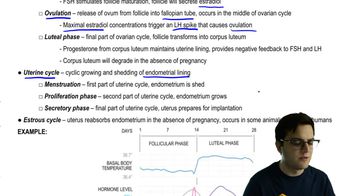 04:01
04:01During human gestation, rudiments of all organs develop
a. In the first trimester
b. In the second trimester
c. In the third trimester
d. During the blastocyst stage
Which of the following characterizes parthenogenesis?
a. An individual may change its sex during its lifetime.
b. Specialized groups of cells grow into new individuals.
c. An organism is first a male and then a female.
d. An egg develops without being fertilized.
In male mammals, excretory and reproductive systems share
a. The vas deferens.
b. The urethra.
c. The seminal vesicle.
d. The prostate.
Which of the following is a true statement?
a. All mammals have menstrual cycles
b. The endometrial lining is shed in menstrual cycles but reabsorbed in estrous cycles
c. Estrous cycles are more frequent than menstrual cycles
d. Ovulation occurs before the endometrium thickens in estrous cycles
Which of the following is not properly paired?
a. Seminiferous tubule—cervix
b. Vas deferens—oviduct
c. Testosterone—estradiol
d. Scrotum—labia majora
For which of the following is the number the same in human males and females?
a. Interruptions in meiotic divisions
b. Functional gametes produced by meiosis
c. Meiotic divisions required to produce each gamete
d. Different cell types produced by meiosis