The pedigree below traces the inheritance of alkaptonuria, a biochemical disorder. Affected individuals, indicated here by the colored circles and squares, are unable to metabolize a substance called alkapton, which colors the urine and stains body tissues. Does alkaptonuria appear to be caused by a dominant allele or by a recessive allele? Fill in the genotypes of the individuals whose genotypes can be deduced. What genotypes are possible for each of the other individuals?
Ch. 14 - Mendel and the Gene Idea
Chapter 14, Problem 14
Imagine that you are a genetic counselor, and a couple planning to start a family comes to you for information. Charles was married once before, and he and his first wife had a child with cystic fibrosis. The brother of his current wife, Elaine, died of cystic fibrosis. What is the probability that Charles and Elaine will have a baby with cystic fibrosis? (Neither Charles, Elaine, nor their parents have cystic fibrosis.)
Verified step by step guidance1
Determine the genetic status of Charles and Elaine. Since Charles had a child with cystic fibrosis (CF) and CF is a recessive disorder, Charles must be a carrier of the CF gene (Ff). Similarly, since Elaine's brother had CF and neither of her parents had the disease, it is likely that both of her parents were carriers, making Elaine likely to be a carrier as well (Ff).
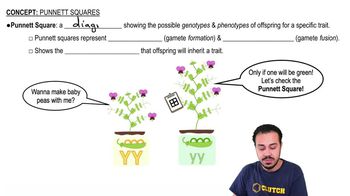
Set up a Punnett square with both Charles and Elaine as carriers (Ff x Ff). This will help visualize the possible genetic outcomes for their children.
Fill in the Punnett square. The possible genotypes of the offspring will be: FF (normal), Ff (carrier), Ff (carrier), and ff (affected by CF).
Calculate the probability of each genotype. Since there is one ff combination out of four possible outcomes, the probability that Charles and Elaine will have a child with CF is 1/4 or 25%.
Explain the results to the couple, emphasizing that there is a 25% chance with each pregnancy that their child will have cystic fibrosis, a 50% chance the child will be a carrier, and a 25% chance the child will neither have CF nor be a carrier.

Verified video answer for a similar problem:
This video solution was recommended by our tutors as helpful for the problem above.
Video duration:
1mWas this helpful?
Key Concepts
Here are the essential concepts you must grasp in order to answer the question correctly.
Cystic Fibrosis Genetics
Cystic fibrosis (CF) is an autosomal recessive disorder caused by mutations in the CFTR gene. For a child to be affected by CF, both parents must carry at least one copy of the mutated gene. If both parents are carriers, there is a 25% chance with each pregnancy that their child will inherit two copies of the mutated gene and thus have cystic fibrosis.
Recommended video:
Guided course
Genetic Code
Carrier Status
A carrier is an individual who has one copy of a mutated gene but does not exhibit symptoms of the associated disorder. In the case of cystic fibrosis, Charles and Elaine are not affected, but Charles's previous child indicates he is likely a carrier. The family history of CF in Elaine's brother also suggests she may be a carrier, increasing the risk of having a child with the condition.
Recommended video:
Guided course
Electron Carriers: NADH & FADH2
Punnett Square
A Punnett square is a tool used in genetics to predict the probability of an offspring inheriting particular traits from its parents. By mapping out the possible combinations of alleles from both parents, one can visualize the likelihood of different genetic outcomes, including the probability of having a child with cystic fibrosis based on the carrier status of both parents.
Recommended video:
Guided course
Punnett Squares
Related Practice
Textbook Question
Textbook Question
In maize (corn) plants, a dominant allele I inhibits kernel color, while the recessive allele i permits color when homozygous. At a different locus, the dominant allele P causes purple kernel color, while the homozygous recessive genotype pp causes red kernels. If plants heterozygous at both loci are crossed, what will be the phenotypic ratio of the offspring?
Textbook Question
In tigers, a recessive allele of a particular gene causes both an absence of fur pigmentation (a white tiger) and a cross-eyed condition. If two phenotypically normal tigers that are heterozygous at this locus are mated, what percentage of their offspring will be cross-eyed? What percentage of cross-eyed tigers will be white?
