Draw the hydration shells that form around a potassium ion and a chloride ion when potassium chloride (KCl) dissolves in water. Label the positive, negative, and partial charges on the atoms.
Ch. 3 - Water and Life
Chapter 3, Problem 3
Measurements show that the pH of a particular lake is 4.0. What is the hydrogen ion concentration of the lake?
a. 4.0 M
b. 10¹⁰M
c. 10⁴M
d. 104M
Verified step by step guidance1
Understand that pH is a measure of the hydrogen ion concentration in a solution. The pH scale ranges from 0 to 14, where lower values indicate higher acidity and higher hydrogen ion concentration.
Recall the formula for calculating pH: \( \text{pH} = -\log_{10}[H^+] \), where \([H^+]\) is the hydrogen ion concentration in moles per liter (M).
Given that the pH of the lake is 4.0, use the formula to find the hydrogen ion concentration: \( 4.0 = -\log_{10}[H^+] \).
To solve for \([H^+]\), rearrange the equation: \([H^+] = 10^{-4} \text{ M}\). This is because taking the antilogarithm (inverse of log) of -4 gives \(10^{-4}\).
Compare the calculated hydrogen ion concentration \(10^{-4} \text{ M}\) with the given options to identify the correct answer.

Verified video answer for a similar problem:
This video solution was recommended by our tutors as helpful for the problem above.
Video duration:
1mWas this helpful?
Key Concepts
Here are the essential concepts you must grasp in order to answer the question correctly.
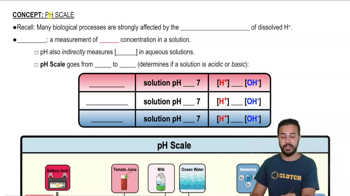
pH Scale
The pH scale is a measure of the acidity or alkalinity of a solution, ranging from 0 to 14. A pH of 7 is neutral, below 7 is acidic, and above 7 is basic. The pH value is the negative logarithm (base 10) of the hydrogen ion concentration, which means a lower pH indicates a higher concentration of hydrogen ions.
Recommended video:
Guided course
pH Scale
Hydrogen Ion Concentration
Hydrogen ion concentration refers to the amount of hydrogen ions present in a solution, which determines its acidity. It is expressed in moles per liter (M). The relationship between pH and hydrogen ion concentration is given by the formula: [H+] = 10^(-pH), where [H+] is the concentration of hydrogen ions.
Recommended video:
Guided course
Hydrogen Bonding
Logarithmic Calculations
Logarithmic calculations are used to convert between pH and hydrogen ion concentration. Since pH is the negative logarithm of the hydrogen ion concentration, calculating the concentration involves using the inverse operation: [H+] = 10^(-pH). For a pH of 4.0, the hydrogen ion concentration is 10^(-4) M, which is 0.0001 M.
Recommended video:
Guided course
Mark & Recapture: Calculations & Assumptions
Related Practice
Textbook Question
5
views
Textbook Question
We can be sure that a mole of table sugar and a mole of vitamin C are equal in their
a. Mass
b. Volume
c. Number of atoms
d. Number of molecules
20
views
1
rank
Textbook Question
A slice of pizza has 500 kcal. If we could burn the pizza and use all the heat to warm a 50-L container of cold water, what would be the approximate increase in the temperature of the water? (Note: A liter of cold water weighs about 1 kg.)
a. 50°C
b. 5°C
c. 100°C
d. 10°C
2
views
Textbook Question
Which of the following is a hydrophobic material?
a. Paper
b. Table salt
c. Wax
d. Sugar
10
views
Textbook Question
What is the hydroxide ion concentration of the lake described in question 3?
a. 10⁻¹⁰ M
b. 10⁻⁴ M
c. 10⁻⁷ M
d. 10.0 M
5
views