 Back
BackAtoms and Chemical Bonding in General Biology
 02:13
02:13
Terms in this set (21)
Matter is anything that takes up space and has mass, including organisms, rocks, and oceans.
An atom is the smallest unit of an element and the smallest unit of matter.
Protons (positively charged), neutrons (neutral), and electrons (negatively charged).
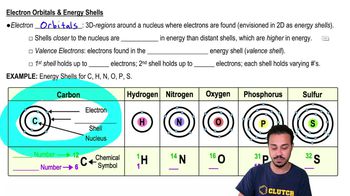
Protons and neutrons are in the nucleus; electrons orbit in electron shells around the nucleus.
The atomic number is the number of protons in the nucleus of an atom and defines the element.
The mass number is the total number of protons and neutrons in the nucleus.
Atomic mass is the average mass of all isotopes of an element; mass number is the total protons plus neutrons in one atom.
Electron shells are 3D regions around the nucleus where electrons are found, arranged in energy levels or shells.
The first shell holds up to 2 electrons; the second shell holds up to 8 electrons.
Valence electrons are the electrons in the outermost energy shell of an atom, important for chemical bonding.
The octet rule states atoms are most stable when their valence shell is full, usually with 8 electrons.
Isotopes are atoms of the same element with the same number of protons but different numbers of neutrons.
A chemical bond is an attractive force between atoms that holds them together to form molecules or compounds.
Intramolecular bonds occur within a molecule; intermolecular bonds occur between different molecules.
Covalent bonds form when two atoms share one or more pairs of electrons.
Nonpolar covalent bonds share electrons equally; polar covalent bonds share electrons unequally due to different electronegativities.
Electronegativity measures an atom's attraction for electrons, ranging from 0 to 4.
Noncovalent bonds are interactions between atoms without sharing electrons, including ionic, hydrogen, and Van der Waals bonds.
Ions are charged atoms or molecules; anions are negatively charged (gain electrons); cations are positively charged (lose electrons).
An ionic bond is an electrical attraction between oppositely charged ions (cations and anions).
A hydrogen bond is a weak interaction between a hydrogen atom bonded to a highly electronegative atom (F, O, or N) and another electronegative atom.