Which term is used to describe populations that live close enough to interbreed?
The term used to describe populations that live close enough to interbreed is 'sympatric populations.'
What example illustrates the biological species concept by describing species that can hybridize but produce sterile offspring?
Two plant species that can hybridize but produce sterile offspring
Which group of organisms can be identified using the biological species concept?
Extant sexually reproducing organisms
Which condition is the basis for a species to be reproductively isolated from other members?
The basis for a species to be reproductively isolated from other members is the presence of reproductive barriers that prevent gene flow.
What criterion does the biological species concept use to identify species?
The biological species concept uses reproductive isolation as the criterion to identify species.
What is a true statement about members of a species regarding their ability to interbreed?
They can interbreed and produce fertile offspring
Which factor determines if two individuals are members of the same species?
The ability to interbreed and produce viable, fertile offspring determines if two individuals are members of the same species.
How does the biological species concept define a species?
The biological species concept defines a species as a group of populations whose members have the potential to interbreed in nature and produce viable, fertile offspring.
Which must be accounted for in any species concept?
Any species concept must account for the criteria used to distinguish one species from another, such as reproductive isolation in the biological species concept.
What is the biological species concept, and how does it define a species?
The biological species concept defines a species as a group of populations whose members are reproductively isolated from other such groups, meaning they do not interbreed in nature or, if they do, do not produce viable or fertile offspring.
Describe postzygotic barriers and list the three main types with a brief explanation of each.
Postzygotic barriers occur after fertilization and reduce the fitness of hybrid offspring. The three main types are: reduced hybrid viability (hybrids are less likely to survive), hybrid sterility (hybrids are healthy but sterile), and hybrid breakdown (first-generation hybrids are fertile, but their offspring are weak or sterile).
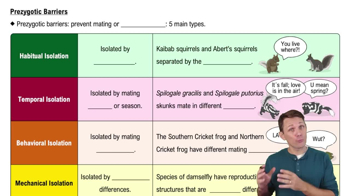
Give an example of each: a prezygotic barrier and a postzygotic barrier, explaining how each prevents gene flow.
A prezygotic barrier example is temporal isolation, where two species mate at different times and thus do not interbreed. A postzygotic barrier example is hybrid sterility, such as a mule (offspring of a horse and donkey), which is healthy but sterile and cannot reproduce, preventing gene flow.
 Back
Back
 02:15
02:15