Skip to main content
General Biology
My Course
Learn
Exam Prep
AI Tutor
Study Guides
Textbook Solutions
Flashcards
Explore
Try the app
My Course
Learn
Exam Prep
AI Tutor
Study Guides
Textbook Solutions
Flashcards
Explore
Try the app
Back
Steps to DNA Cloning quiz #1
You can tap to flip the card.
What is the first step in DNA cloning?
You can tap to flip the card.
👆
What is the first step in DNA cloning?
The first step in DNA cloning is creating the recombinant DNA.
Track progress
Control buttons has been changed to "navigation" mode.
1/15
Related flashcards
Related practice
Recommended videos
Steps to DNA Cloning definitions
Steps to DNA Cloning
20 Terms
Steps to DNA Cloning exam
Steps to DNA Cloning
29 Terms
Steps to DNA Cloning
18. Biotechnology
6 problems
Topic
Jason
Introduction to Polymerase Chain Reaction
18. Biotechnology
3 problems
Topic
Jason
18. Biotechnology - Part 1 of 2
5 topics
10 problems
Chapter
Jason
18. Biotechnology - Part 2 of 2
5 topics
9 problems
Chapter
Jason
04:42
Steps to DNA Cloning
5
views
04:58
1b) Use Ligation Enzymes
4
views
03:27
1a) Use Restriction Enzymes
7
views
Terms in this set (15)
Hide definitions
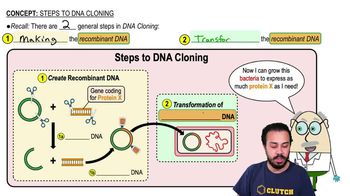
What is the first step in DNA cloning?
The first step in DNA cloning is creating the recombinant DNA.
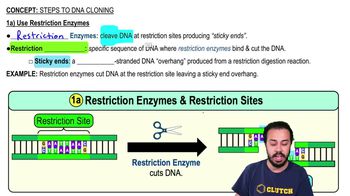
What role do restriction enzymes play in DNA cloning?
Restriction enzymes act like molecular scissors to cut DNA at specific restriction sites.
What are sticky ends in the context of DNA cloning?
Sticky ends are single-stranded DNA overhangs produced by restriction enzyme cuts.
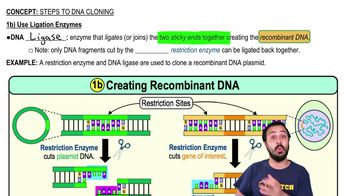
What is the function of DNA ligase in DNA cloning?
DNA ligase acts like glue to covalently join the sticky ends of DNA fragments.
Why can only DNA fragments cut by the same restriction enzyme be ligated together?
Only DNA fragments cut by the same restriction enzyme have matching sticky ends that can be ligated together.
What is transformation in the context of DNA cloning?
Transformation is the process by which cells uptake foreign DNA from their environment.
What is a transgenic organism?
A transgenic organism is one that has received and expressed recombinant DNA from a different species.
How can scientists confirm a successful transformation in bacteria?
Scientists use phenotypic markers, such as antibiotic resistance, to confirm successful transformation.
What is the role of a cloning vector in DNA cloning?
A cloning vector, such as a recombinant DNA molecule, is used to insert the gene of interest into a host cell.
How is human insulin produced using DNA cloning?
Human insulin is produced by inserting the human insulin gene into transgenic E. coli, which then express and replicate the gene.
What is the purpose of the polymerase chain reaction (PCR) in DNA studies?
PCR is used to rapidly isolate and amplify a specific sequence of DNA.
How does PCR differ from DNA cloning?
PCR amplifies DNA in a test tube without using living cells, unlike DNA cloning which uses living cells.
What are restriction sites?
Restriction sites are specific DNA sequences where restriction enzymes bind and cut the DNA.
What is the significance of sticky ends in DNA cloning?
Sticky ends allow for the complementary base pairing necessary for ligating DNA fragments together.
What is the final product of the first step in DNA cloning?
The final product of the first step in DNA cloning is the recombinant DNA molecule.
 BackBack
 04:42
04:42