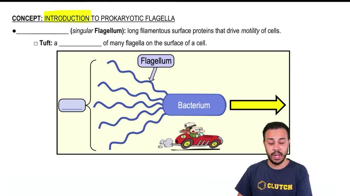
Which statement accurately describes bacterial flagella?
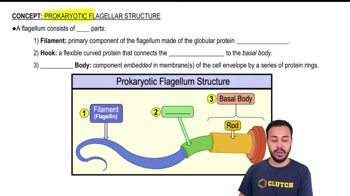
Bacterial flagella are long filamentous surface proteins composed of flagellin, a hook, and a basal body, which facilitate cell motility by acting as a propeller.
What is the role of flagella in prokaryotic cells?
Flagella in prokaryotic cells are responsible for motility, allowing the cell to move through its environment by propelling it in specific directions.
What type of bacterial cell has only a single flagellum?
Monotrichous
How do axial filaments differ from regular bacterial flagella?
Axial filaments are internal structures found in spirochetes that wrap around the cell, allowing it to move in a corkscrew motion, unlike external flagella.
How do bacteria move using flagella?
Bacteria move using flagella by rotating them like a propeller, which allows the cell to navigate through its environment in a series of runs and tumbles.
What organelle do spirochetes use to propel themselves?
Axial filaments
What are types of flagellar arrangements that have more than one flagellum?
B) Lophotrichous and D) Peritrichous
In which groups of organisms would you find flagella as motility structures?
Flagella are found as motility structures in both prokaryotic organisms, such as bacteria, and eukaryotic organisms, such as certain protists and sperm cells.
What does gliding motility in bacteria involve?
C) Surface proteins
Which structures do paramecia use to move around?
Paramecia use cilia to move around, which are short hair-like structures that beat in coordinated waves to propel the cell.
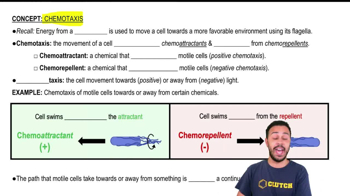
What is chemotaxis in prokaryotes, and how do cells achieve movement toward or away from chemical signals?
Chemotaxis is the movement of prokaryotic cells toward chemoattractants (positive chemotaxis) and away from chemorepellants (negative chemotaxis). Cells achieve this movement using flagella, which propel them through their environment in response to chemical gradients.
 Back
Back
 02:40
02:40