Skip to main content
General Biology
My Course
Learn
Exam Prep
AI Tutor
Study Guides
Textbook Solutions
Flashcards
Explore
Try the app
My Course
Learn
Exam Prep
AI Tutor
Study Guides
Textbook Solutions
Flashcards
Explore
Try the app
Back
Introduction to Terrestrial Biomes quiz #2
You can tap to flip the card.
Where are savannas typically found?
You can tap to flip the card.
👆
Where are savannas typically found?
Savannas are typically found in regions with warm temperatures, such as parts of Africa, South America, and Australia.
Track progress
Control buttons has been changed to "navigation" mode.
1/36
Related flashcards
Related practice
Recommended videos
Introduction to Terrestrial Biomes exam
Introduction to Terrestrial Biomes
29 Terms
Introduction to Terrestrial Biomes quiz #3
Introduction to Terrestrial Biomes
38 Terms
Introduction to Terrestrial Biomes quiz #4
Introduction to Terrestrial Biomes
40 Terms
Introduction to Terrestrial Biomes
48. Ecology
5 problems
Topic
Terrestrial Biomes: Near Equator
48. Ecology
4 problems
Topic
48. Ecology - Part 1 of 3
4 topics
12 problems
Chapter
Jason
48. Ecology - Part 2 of 3
4 topics
9 problems
Chapter
48. Ecology - Part 3 of 3
2 topics
5 problems
Chapter
01:29
Introduction to Terrestrial Biomes Example 2
4
views
01:55
Introduction to Terrestrial Biomes
8
views
00:49
Introduction to Terrestrial Biomes Example 1
3
views
Terms in this set (36)
Hide definitions
Where are savannas typically found?
Savannas are typically found in regions with warm temperatures, such as parts of Africa, South America, and Australia.
Which of these biomes is characterized by little rainfall?
Deserts are characterized by little rainfall.
Which of these animals would most likely be found in a tundra biome?
Animals like polar bears, arctic foxes, and caribou are typically found in tundra biomes.
The presence of permafrost is a characteristic of which major biome?
The tundra biome is characterized by the presence of permafrost.
Which biome is characterized by the presence of permafrost?
The tundra biome is characterized by the presence of permafrost.
How does a savanna differ from a grassland?
Savannas have scattered trees and are typically warmer with seasonal rainfall, while grasslands have fewer trees and more consistent rainfall.
What is one difference between savanna and grassland biomes?
Savannas have scattered trees and seasonal rainfall, while grasslands have fewer trees and more consistent rainfall.
Which of these is the largest terrestrial biome on Earth?
The taiga, or boreal forest, is the largest terrestrial biome on Earth.
Which biome is prominent in North America? a. Taiga b. Savanna c. Rainforest d. Chaparral
a. Taiga
Which biome is characterized by short growing seasons?
The tundra biome is characterized by short growing seasons.
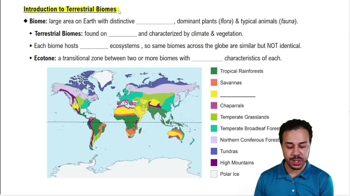
What defines a biome?
Biomes are large areas characterized by distinct climates, flora, and fauna.
Which biome covers the largest part of Earth's surface?
The taiga, or boreal forest, covers the largest part of Earth's terrestrial surface.
What are the abiotic factors that typically define a biome?
Abiotic factors include climate, soil type, and availability of water.
What two characteristics are the most important in determining the distribution of a biome?
Climate and vegetation are the most important characteristics in determining the distribution of a biome.
Which biome is characterized by permafrost?
The tundra biome is characterized by permafrost.
What attribute is characteristic of savannas but not of grasslands?
Savannas are characterized by scattered trees and seasonal rainfall.
What are features of an arboreal habitat?
Features include trees and vegetation that support life above ground.
Which biome receives the most rain?
Tropical rainforests receive the most rain.
In which biome are you most likely to find grasses?
Grasslands are most likely to have abundant grasses.
What is not a characteristic of the rainforest biome?
Rainforests are not characterized by low rainfall; they receive high amounts of precipitation.
Why is the tundra treeless?
The tundra is treeless due to low temperatures, short growing seasons, and permafrost.
Which biome is characterized by a layer of permafrost?
The tundra biome is characterized by a layer of permafrost.
Which biome has long cold winters and short summers?
The taiga, or boreal forest, has long cold winters and short summers.
What is not a terrestrial biome?
Aquatic biomes are not terrestrial biomes.
What is the main reason that the tundra does not have large plants?
The tundra lacks large plants due to permafrost and short growing seasons.
What is not true of deciduous forests?
Deciduous forests do not have evergreen trees; they have trees that shed leaves seasonally.
Which biome type occupies the largest area on Earth?
The taiga, or boreal forest, occupies the largest area on Earth.
Where are Earth's most diverse and productive biomes located?
Earth's most diverse and productive biomes are located in tropical rainforests.
Which biome is characterized by a layer of permanently frozen land?
The tundra biome is characterized by a layer of permanently frozen land.
What is an abiotic factor in a biome?
Climate is an abiotic factor in a biome.
What do deserts and chaparral have in common?
Both deserts and chaparral have low precipitation and can experience extreme temperatures.
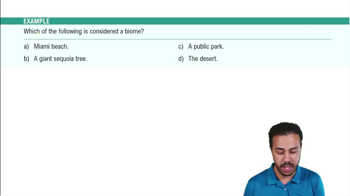
What is an example of something that is not a biome?
A city is not a biome.
The changing of 4 distinct seasons is best viewed in which biome?
Temperate deciduous forests experience four distinct seasons.
What are the characteristics of a savanna?
Savannas are characterized by warm temperatures, seasonal rainfall, and scattered trees.
Which of these biomes generally lies between tundra and temperate broadleaf forest?
The taiga, or boreal forest, generally lies between tundra and temperate broadleaf forest.
How are biomes classified?
Biomes are classified based on climate, vegetation, and geographic location.
 BackBack
 01:29
01:29