Why are the structures of plants ideal for photosynthesis and plant reproduction?
The structures of plants, such as leaves and flowers, are ideal for photosynthesis and reproduction because they maximize light absorption and facilitate pollination and seed dispersal.
How are animals involved in the life cycle of plants?
Animals are involved in the life cycle of plants by pollinating flowers and dispersing seeds.
What role do producers play?
Producers play the role of converting light energy into chemical energy, forming the base of the food chain.
What materials pass through stomata?
Carbon dioxide, oxygen, and water vapor pass through stomata.
Which organisms can perform photosynthesis?
Plants
Where in plants do carbon dioxide and oxygen enter/exit?
Carbon dioxide and oxygen enter/exit through the stomata in plants.
Which gets its energy from sunlight and its carbon from ingesting other organisms?
This describes a photoheterotroph, but typical plants are photoautotrophs, getting energy from sunlight and carbon from CO2.
What is the process in which water evaporates from leaves?
The process in which water evaporates from leaves is called transpiration.
How many different types of photosystems are found in the chloroplasts of green plants?
There are two different types of photosystems found in the chloroplasts of green plants: Photosystem I and Photosystem II.
What structures inside plant cells help with photosynthesis?
Chloroplasts inside plant cells help with photosynthesis.
What is transpiration?
Transpiration is the process by which water vapor is released from plant leaves into the atmosphere.
In which region are photosynthetic organisms absent?
Deep ocean
What component is found in both PSI and PSII?
Chlorophyll
What is the role of companion cells in the movement of sugars through plants?
Companion cells assist in the loading and unloading of sugars into the phloem for transport throughout the plant.
Which organelle is found in photosynthetic organisms and captures energy from the sun?
The chloroplast is found in photosynthetic organisms and captures energy from the sun.
What is the function of stomata?
Stomata regulate gas exchange and water loss.
Why is it important that the spongy mesophyll has gaps or air spaces in its layers?
The gaps or air spaces in the spongy mesophyll allow for efficient gas exchange, facilitating the movement of carbon dioxide and oxygen.
In which process is the enzyme rubisco involved?
Calvin cycle
Which statement describes the role of phloem within a plant?
Phloem transports sugars and other organic nutrients from the leaves to other parts of the plant.
Where in the eukaryotic cells does photosynthesis occur?
Photosynthesis occurs in the chloroplasts of eukaryotic cells.
Primary producers in marine systems include which group?
Primary producers in marine systems include phytoplankton and algae.
What are the two processes used by producers to obtain energy?
The two processes used by producers to obtain energy are photosynthesis and chemosynthesis.
How do chloroplasts get energy from sunlight?
Chloroplasts get energy from sunlight through chlorophyll, which absorbs light energy for photosynthesis.
What term is used to describe organisms that obtain their energy by eating only plants?
Herbivores are organisms that obtain their energy by eating only plants.
Which part of a plant cell captures sunlight and converts the energy into food?
The chloroplast captures sunlight and converts the energy into food.
What is the main function of the leaves?
The main function of the leaves is to perform photosynthesis, converting light energy into chemical energy.
Photosynthesis occurs in what organelle?
Photosynthesis occurs in the chloroplast.
Which of these processes is responsible for leaves being considered sugar sources?
Photosynthesis is responsible for leaves being considered sugar sources.
What is the primary role of the chloroplast?
The primary role of the chloroplast is to conduct photosynthesis, converting light energy into chemical energy.
What are usually the first photosynthetic organisms to colonize during primary succession?
Lichens and mosses are usually the first photosynthetic organisms to colonize during primary succession.
How does photosynthesis provide energy for birds?
Photosynthesis provides energy for birds by producing glucose, which enters the food chain and is consumed by birds.
Which is an example of a producer? A) Deer B) Oak tree C) Wolf D) Mushroom
B) Oak tree
Why are animal cells not capable of carrying out photosynthesis?
Animal cells are not capable of carrying out photosynthesis because they lack chloroplasts.
Which Earth system includes photosynthesis?
Biosphere
What would happen if the stomata of a leaf remained closed all day? Select all that apply. A) Photosynthesis would decrease. B) Water loss would increase. C) Gas exchange would be limited. D) Oxygen levels inside the leaf would increase.
A) Photosynthesis would decrease. C) Gas exchange would be limited.
What is photosynthesis?
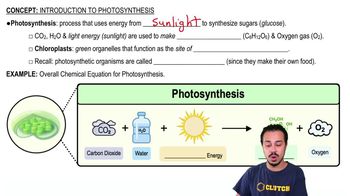
Photosynthesis is the process by which organisms use energy from sunlight to synthesize sugars, such as glucose, from carbon dioxide and water, producing oxygen as a byproduct.
What are the main reactants required for photosynthesis?
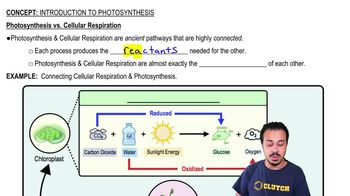
The main reactants required for photosynthesis are carbon dioxide (CO2), water (H2O), and sunlight.
What is the chemical equation for photosynthesis?
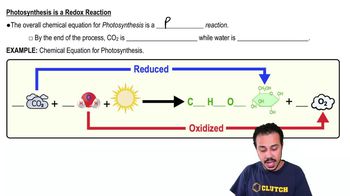
The chemical equation for photosynthesis is: 6CO2 + 6H2O + light energy → C6H12O6 + 6O2.
 Back
Back
 03:32
03:32