Skip to main content
General Biology
My Course
Learn
Exam Prep
AI Tutor
Study Guides
Textbook Solutions
Flashcards
Explore
Try the app
My Course
Learn
Exam Prep
AI Tutor
Study Guides
Textbook Solutions
Flashcards
Explore
Try the app
Back
Introduction to Photosynthesis quiz #2
You can tap to flip the card.
What are the products of photosynthesis?
You can tap to flip the card.
👆
What are the products of photosynthesis?
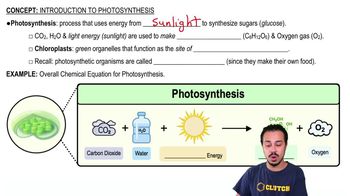
The products of photosynthesis are glucose (C6H12O6) and oxygen (O2).
Track progress
Control buttons has been changed to "navigation" mode.
1/39
Related flashcards
Related practice
Recommended videos
Introduction to Photosynthesis definitions
Introduction to Photosynthesis
8 Terms
Introduction to Photosynthesis quiz #1
Introduction to Photosynthesis
35 Terms
Introduction to Photosynthesis exam
Introduction to Photosynthesis
29 Terms
Introduction to Photosynthesis
9. Photosynthesis
4 problems
Topic
Jason
Leaf & Chloroplast Anatomy
9. Photosynthesis
4 problems
Topic
Jason
9. Photosynthesis - Part 1 of 2
6 topics
8 problems
Chapter
Jason
9. Photosynthesis - Part 2 of 2
5 topics
8 problems
Chapter
Jason
03:32
Introduction to Photosynthesis
14
views
1
rank
07:55
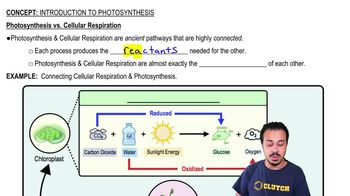
Photosynthesis vs. Cellular Respiration
9
views
03:20
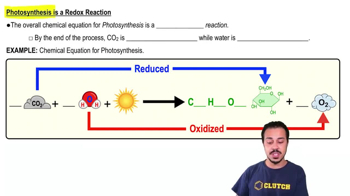
Photosynthesis is a Redox Reaction
1
views
Terms in this set (39)
Hide definitions
What are the products of photosynthesis?
The products of photosynthesis are glucose (C6H12O6) and oxygen (O2).
Where does photosynthesis take place?
Photosynthesis takes place in the chloroplasts of plant cells.
What is the equation for photosynthesis?
The equation for photosynthesis is 6CO2 + 6H2O + light energy -> C6H12O6 + 6O2.
Photosynthesis occurs inside of which organelle?
Photosynthesis occurs inside the chloroplast.
Where within the cell does photosynthesis take place?
Photosynthesis takes place within the chloroplasts of the cell.
What is the correct distinction between autotrophs and heterotrophs?
Autotrophs produce their own food.
Why do plant cells need chloroplasts?
Plant cells need chloroplasts to capture light energy and convert it into chemical energy through photosynthesis.
Which part of the human body is most similar to stomata in plants?
The lungs are most similar to stomata in plants as both facilitate gas exchange.
Which describes a disruption in the water cycle that could affect photosynthesis?
A drought could reduce water availability, affecting photosynthesis by limiting the water needed for the process.
What is the main function of leaves?
The main function of leaves is to perform photosynthesis, capturing light energy to produce food for the plant.
How do plants contribute to the water cycle?
Plants contribute to the water cycle through transpiration, releasing water vapor into the atmosphere.
Which statement describes all primary producers?
All primary producers can convert light energy into chemical energy through photosynthesis.
Where does the producer get its energy?
Producers get their energy from sunlight through the process of photosynthesis.
Where do producers get their energy from?
Producers get their energy from sunlight through photosynthesis.
What do plants need to perform photosynthesis?
Plants need sunlight, carbon dioxide, and water to perform photosynthesis.
How does a plant increase its biomass?
A plant increases its biomass by converting carbon dioxide and water into glucose through photosynthesis.
Water exits the leaves of plants and enters the atmosphere. What is this process called?
This process is called transpiration.
In which form do plants store energy?
Plants store energy in the form of glucose.
What opens and closes the stomata?
Guard cells open and close the stomata.
How does carbon dioxide enter the leaf?
Carbon dioxide enters the leaf through the stomata.
Which process provides plants with the glucose needed for cellular respiration?
Photosynthesis provides plants with the glucose needed for cellular respiration.
Which organism is a producer in this food chain?
Plants are producers in a food chain.
Which plant cell organelle uses light energy to produce sugar?
The chloroplast uses light energy to produce sugar.
What is the energy autotrophs use to make their own food?
Autotrophs use light energy from the sun to make their own food.
Which plant structure provides most of the water necessary for photosynthesis?
Roots
Which process in living things evolved as oxygen levels increased in Earth’s atmosphere?
Cellular respiration evolved as oxygen levels increased in Earth’s atmosphere.
Which organelles convert solar energy into glucose and oxygen?
Chloroplasts
In which organelle do the chemical reactions of photosynthesis occur?
The chemical reactions of photosynthesis occur in the chloroplast.
Where are Photosystems I and II found?
Photosystems I and II are found in the thylakoid membranes of the chloroplast.
Photosynthesis occurs in which organelle?
Photosynthesis occurs in the chloroplast.
What is the function of stomata?
The function of stomata is to allow gas exchange, letting carbon dioxide in and oxygen out.
Which statement describes the relationship between plants and photosynthesis?
Plants perform photosynthesis to convert light energy into chemical energy stored in glucose.
What are the roles of ATP and NADPH in photosynthesis?
ATP and NADPH provide energy and reducing power, respectively, for the Calvin cycle in photosynthesis.
What is the function of chloroplast?
The function of the chloroplast is to conduct photosynthesis, converting light energy into chemical energy.
Specifically in which organelle does photosynthesis happen?
Photosynthesis specifically happens in the chloroplast.
Which organelle is responsible for photosynthesis?
The chloroplast is responsible for photosynthesis.
What pattern did scientists observe in plant cells in different light conditions?
Scientists observed that chloroplasts move within plant cells to optimize light absorption under different light conditions.
Which structures do plant cells have for making food that animal cells do not?
Plant cells have chloroplasts for making food, which animal cells do not have.
What process do plants use to release excess water into the atmosphere?
Transpiration
 BackBack
 03:32
03:32