Skip to main content
General Biology
My Course
Learn
Exam Prep
AI Tutor
Study Guides
Textbook Solutions
Flashcards
Explore
Try the app
My Course
Learn
Exam Prep
AI Tutor
Study Guides
Textbook Solutions
Flashcards
Explore
Try the app
Back
Introduction to Meiosis quiz #5
You can tap to flip the card.
How many cells are there after telophase I?
You can tap to flip the card.
👆
How many cells are there after telophase I?
There are two haploid cells after telophase I.
Track progress
Control buttons has been changed to "navigation" mode.
1/39
Related flashcards
Related practice
Recommended videos
Introduction to Meiosis definitions
Introduction to Meiosis
9 Terms
Introduction to Meiosis quiz #1
Introduction to Meiosis
47 Terms
Introduction to Meiosis exam
Introduction to Meiosis
22 Terms
Introduction to Meiosis
12. Meiosis
3 problems
Topic
Jason
Meiosis I
12. Meiosis
4 problems
Topic
Jason
12. Meiosis
8 topics
15 problems
Chapter
Jason
01:43
Introduction to Meiosis Example 1
3
views
04:49
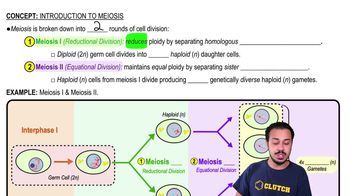
Meiosis I & Meiosis II
1
views
04:33
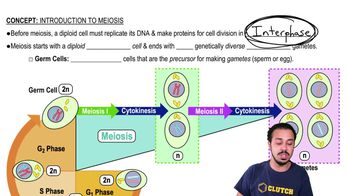
Introduction to Meiosis
4
views
Terms in this set (39)
Hide definitions
How many cells are there after telophase I?
There are two haploid cells after telophase I.
What happens during meiosis that does not happen during mitosis?
Crossing over and the reduction of chromosome number happen during meiosis but not mitosis.
What is the outcome of meiosis regarding the number and genetic diversity of gametes?
Meiosis results in four genetically diverse haploid gametes.
What does the process of meiosis contribute to?
The process of meiosis contributes to genetic diversity and the production of gametes for sexual reproduction.
Homologous chromosomes are moved to opposite poles of the cell during what meiotic phase?
Homologous chromosomes are moved to opposite poles during anaphase I of meiosis.
In what phase of meiosis does crossing over occur?
Crossing over occurs during prophase I of meiosis.
During what phase of meiosis does crossing over occur?
Crossing over occurs during prophase I of meiosis.
How are haploid and diploid cells different?
Haploid cells contain one set of chromosomes, while diploid cells contain two sets of chromosomes.
Which division during meiosis is very similar to the division that occurs during mitosis?
Meiosis II is very similar to mitosis because it involves the separation of sister chromatids.
What is the correct order of phases for meiosis I and meiosis II?
The correct order is prophase I, metaphase I, anaphase I, telophase I, prophase II, metaphase II, anaphase II, and telophase II.
What is the difference between anaphase I and anaphase II?
In anaphase I, homologous chromosomes are separated, while in anaphase II, sister chromatids are separated.
What is crossing over and when does it happen?
Crossing over is the exchange of genetic material between homologous chromosomes, occurring during prophase I of meiosis.
At which stage(s) of meiosis I are the cells diploid and at which stage(s) are they haploid?
Cells are diploid during prophase I, metaphase I, and anaphase I, and become haploid after telophase I.
What occurs during prophase I of meiosis in animal cells?
During prophase I, synapsis and crossing over occur, and homologous chromosomes pair up to form tetrads.
During which phase of meiosis are sister chromatids separated?
Sister chromatids are separated during anaphase II of meiosis.
When does crossing-over occur?
Crossing-over occurs during prophase I of meiosis.
What processes occur during meiosis?
Crossing over and the separation of homologous chromosomes occur during meiosis.
During which phase of meiosis do homologous chromosomes separate?
Homologous chromosomes separate during anaphase I of meiosis.
During which phase of meiosis will bivalents form?
Bivalents form during prophase I of meiosis.
Which process can be described as two cell divisions
Meiosis can be described as two cell divisions: meiosis I and meiosis II.
For which biological process does meiosis produce cells?
Meiosis produces cells for sexual reproduction.
During what stage of meiosis does crossing over occur?
Crossing over occurs during prophase I of meiosis.
In which phase of meiosis does crossing over occur?
Crossing over occurs during prophase I of meiosis.
What is the difference between diploid and haploid cells?
Diploid cells contain two sets of chromosomes, while haploid cells contain one set of chromosomes.
During which phase of meiosis will homologous chromosomes move to opposite poles?
Homologous chromosomes move to opposite poles during anaphase I of meiosis.
Which describes the four cells that are produced at the end of meiosis?
The four cells produced at the end of meiosis are genetically diverse haploid gametes.
In anaphase I in meiosis what is being pulled to opposite sides of the cell?
In anaphase I, homologous chromosomes are being pulled to opposite sides of the cell.
What is true about meiosis?
Meiosis results in four genetically diverse haploid gametes.
How many nuclear divisions occur in meiosis?
Two nuclear divisions occur in meiosis: meiosis I and meiosis II.
A chicken cell undergoes meiosis
A chicken cell undergoing meiosis will produce four genetically diverse haploid gametes.
How many cells are produced from meiosis?
Four cells are produced from meiosis.
Which stage of meiosis I is represented by the illustration?
Without the illustration, it's not possible to determine the stage, but stages include prophase I, metaphase I, anaphase I, and telophase I.
How many cells are produced during meiosis?
Four cells are produced during meiosis.
During which phase does crossing over normally take place?
Crossing over normally takes place during prophase I of meiosis.
During which stage of meiosis will sister chromatids separate and go to opposite poles?
Sister chromatids separate and go to opposite poles during anaphase II of meiosis.
During what stage of meiosis do sister chromatids separate from each other?
Sister chromatids separate from each other during anaphase II of meiosis.
During which phase of meiosis do sister chromatids separate?
Sister chromatids separate during anaphase II of meiosis.
How does meiosis help explain Mendel’s principle of independent assortment?
Meiosis explains Mendel's principle of independent assortment through the random orientation of homologous chromosomes during metaphase I.
What produces four daughter cells?
Meiosis produces four daughter cells.
 BackBack
 01:43
01:43