How do homologous chromosomes differ from chromatids?
Homologous chromosomes are similar but not identical chromosomes from each parent, while chromatids are identical copies of a single chromosome.
How many chromosomes are found in human somatic cells?
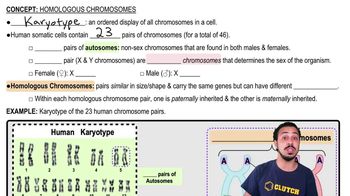
Human somatic cells contain 46 chromosomes.
What is true of homologous chromosomes?
They carry the same genes but may have different alleles.
How many chromosome pairs occur in a normal human somatic cell?
There are 23 chromosome pairs in a normal human somatic cell.
What pulls the chromosomes of a homologous pair to opposite poles?
The spindle fibers pull the chromosomes of a homologous pair to opposite poles during cell division.
How many sets of chromosomes do the cells of many eukaryotic species have?
Many eukaryotic species have two sets of chromosomes, one from each parent, making them diploid.
What characteristics do homologous chromosomes exhibit?
Similar in size, shape, and gene content
How are sister chromatids different from homologous chromosomes?
Sister chromatids are identical copies of a chromosome, while homologous chromosomes are similar but not identical chromosomes from each parent.
How many pairs of chromosomes do humans have?
Humans have 23 pairs of chromosomes.
How many chromosomes are in the middle cell?
This question is incomplete without context, but a typical human somatic cell has 46 chromosomes.
What is the term for pairs of chromosomes that are similar in size, shape, and gene content?
The term for such pairs of chromosomes is homologous chromosomes.
Which correctly defines homologous structures?
Homologous structures are anatomical features in different species that have a similar structure due to a common evolutionary origin.
How many pairs of chromosomes do human cells have?
Human cells have 23 pairs of chromosomes.
Which is true of homologous chromosomes? (a) They are identical in every way. (b) They carry the same genes but may have different alleles. (c) They are only found in haploid cells. (d) They are connected by a centromere.
b) They carry the same genes but may have different alleles.
What is true about chromosomes in multicellular organisms?
All cells have the same number of chromosomes.
How many chromosomes does each cell have?
Each human somatic cell contains 46 chromosomes.
If a chicken's chromosomes are ZW, what does this indicate about its sex?
In chickens, ZW indicates a female, while ZZ indicates a male.
How many chromosomes do humans have in each cell?
Humans have 46 chromosomes in each somatic cell.
When do homologous chromosomes separate?
Homologous chromosomes separate during anaphase I of meiosis.
How many chromosomes do non-reproductive cells have?
Non-reproductive (somatic) cells in humans have 46 chromosomes.
Chromatids that are attached at the centromere are called what kind of chromatids?
Chromatids that are attached at the centromere are called sister chromatids.
How many chromosomes do you have?
Humans typically have 46 chromosomes.
If the diploid chromosome count in humans is 46, what is the haploid number?
The haploid number in humans is 23.
Are homologous chromosomes identical?
No, homologous chromosomes are similar but not identical; they carry the same genes but may have different alleles.
How many homologous pairs are there in human cells?
There are 23 homologous pairs in human cells.
How many chromosomes does a dog have?
Dogs have 78 chromosomes.
What is a true statement about homologous structures in two different organisms?
They have a similar structure due to a common ancestor.
If a dog cell has 72 chromosomes, how many chromosomes are in its gametes?
The gametes would have 36 chromosomes, as they are haploid.
In a diploid organism, how many sets of chromosomes are present?
In a diploid organism, there are two sets of chromosomes.
Which kind(s) of cells have pairs of chromosomes?
Diploid cells have pairs of chromosomes.
What is the relationship between chromosomes and alleles?
Chromosomes carry genes, and alleles are different versions of those genes.
When each homologous chromosome is copied, what are the resulting structures called?
The resulting structures are called sister chromatids.
What are homologous genes?
Homologous genes are genes that are similar in sequence and function across different species due to a common evolutionary origin.
Once the chromosomes have formed a pair, what are they called?
Once chromosomes have formed a pair, they are called homologous chromosomes.
Why are chromosomes called homologous chromosomes after prophase I?
They are called homologous chromosomes because they pair up and align with each other during prophase I of meiosis.
A diploid cell has how many times the number of chromosomes as a haploid cell?
A diploid cell has twice the number of chromosomes as a haploid cell.
What characteristics do two homologous chromosomes share?
Two homologous chromosomes share similar size, shape, and gene content but may have different alleles.
How many chromosomes are in each set of human chromosomes?
Each set of human chromosomes contains 23 chromosomes.
If you start with 10 chromosomes, how many chromosomes will be in each daughter cell after mitosis?
Each daughter cell will have 10 chromosomes after mitosis.
 Back
Back
 08:09
08:09