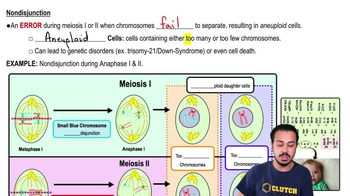
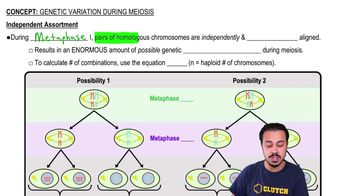
What function does recombination by crossing-over have in genetic variation?
Recombination by crossing-over increases genetic variation by exchanging genetic material between homologous chromosomes, resulting in non-identical sister chromatids.
Which of these gametes contain one or more recombinant chromosomes?
Gametes that have undergone crossing over during meiosis contain one or more recombinant chromosomes.
What happens during crossing over?
During crossing over, homologous chromosomes exchange segments of DNA, leading to genetic recombination and increased genetic diversity.
Which mode of genetic recombination is matched correctly with its description? A) Crossing over - exchange of genetic material between non-homologous chromosomes B) Independent assortment - random alignment of homologous chromosomes C) Nondisjunction - proper separation of chromosomes
B) Independent assortment - random alignment of homologous chromosomes
How many homologous chromosome alignments are possible for independent assortment during meiosis?
The number of possible alignments is 2^n, where n is the haploid number of chromosomes.
How do meiosis I and II contribute to genetic variation?
Meiosis I contributes through crossing over and independent assortment, while meiosis II separates sister chromatids, further increasing genetic diversity.
Why is crossing over important?
Crossing over is important because it increases genetic diversity by creating new combinations of alleles on chromosomes.
In what two ways does meiosis produce genetic variation?
Meiosis produces genetic variation through crossing over and independent assortment.
How does crossing over increase genetic diversity?
Crossing over increases genetic diversity by exchanging genetic material between homologous chromosomes, resulting in new allele combinations.
What happens when chromosomes cross over?
When chromosomes cross over, they exchange segments of DNA, leading to genetic recombination and increased genetic diversity.
What is the name for the sites of crossing over in a chromosome?
The sites of crossing over in a chromosome are called chiasmata.
Are the genes on a recombinant chromatid the same as the original chromatid?
No, the genes on a recombinant chromatid are different due to the exchange of genetic material during crossing over.
Which process of genetic recombination involves genes from both parents?
Crossing over involves genetic recombination of genes from both parents.
What is the effect of crossing over on genetic diversity?
It increases genetic diversity
What features of meiosis allow for independent assortment of chromosomes?
The random alignment of homologous chromosome pairs during metaphase I allows for independent assortment.
What process causes independent assortment of chromosomes during meiosis?
Random alignment during metaphase I
During which process are chromosomal segments exchanged between a pair of homologous chromosomes?
Chromosomal segments are exchanged during crossing over.
How could crossing over affect the distribution of the four alleles: A, B, C, and D?
Crossing over can create new combinations of these alleles on the chromosomes, leading to genetic diversity.
Why is crossing-over important?
Crossing-over is important because it increases genetic diversity by creating new combinations of alleles on chromosomes.
How many amino acids differ between the monkey and the human sequences?
This question is unrelated to the topic of genetic variation during meiosis.
What is the result of crossing over?
The result of crossing over is the formation of recombinant chromosomes with new combinations of alleles.
What happens during crossing over in meiosis?
During crossing over in meiosis, homologous chromosomes exchange genetic material, leading to genetic recombination.
What happens during crossing over and what is the significance?
During crossing over, homologous chromosomes exchange DNA segments, increasing genetic diversity and creating new allele combinations.
How does crossing over contribute to genetic diversity?
Crossing over contributes to genetic diversity by exchanging genetic material between homologous chromosomes, resulting in new allele combinations.
What function does recombination by crossing-over have in genetic variation?
Recombination by crossing-over increases genetic variation by exchanging genetic material between homologous chromosomes, resulting in non-identical sister chromatids.
When homologous chromosomes cross over, what occurs?
When homologous chromosomes cross over, they exchange segments of DNA, leading to genetic recombination and increased genetic diversity.
In what stage of meiosis does genetic variation occur?
Genetic variation occurs during prophase I and metaphase I of meiosis.
What results when homologous chromosomes cross over in meiosis?
Recombinant chromatids
Why does meiosis result in greater genetic diversity than mitosis?
Meiosis results in greater genetic diversity due to crossing over and independent assortment, which do not occur in mitosis.
How can offspring have traits that neither parent has?
Offspring can have traits that neither parent has due to genetic recombination during crossing over and independent assortment.
What occurs during crossing over?
During crossing over, homologous chromosomes exchange segments of DNA, leading to genetic recombination and increased genetic diversity.
What is the significance of crossing over?
The significance of crossing over is that it increases genetic diversity by creating new combinations of alleles on chromosomes.
What is the importance of crossing over?
The importance of crossing over is that it increases genetic diversity by creating new combinations of alleles on chromosomes.
What causes genetic variation in meiosis?
Genetic variation in meiosis is caused by crossing over and independent assortment.
What does crossing over involve in terms of genetic material exchange?
Exchange of genetic material between homologous chromosomes
What process contributes to genetic variation in sexually reproducing species?
Crossing over
Which process does not generate genetic variation during sexual reproduction?
Mitosis
What characterizes the independent assortment of genes into gametes?
Independent assortment is characterized by the random alignment of homologous chromosomes during metaphase I, leading to diverse genetic combinations.
How many genetically distinct gametes are produced if crossing over does not take place?
The number of genetically distinct gametes is determined by 2^n, where n is the haploid number of chromosomes.
 Back
Back

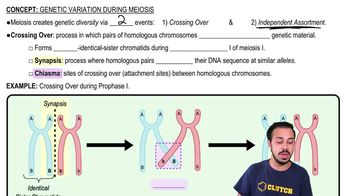
 07:08
07:08