Describe the mechanism of cytokinesis in animal cells.
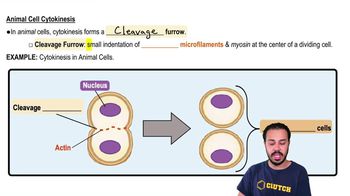
In animal cells, cytokinesis occurs through the formation of a cleavage furrow, which is created by contractile actin and myosin filaments that pinch the cell into two separate daughter cells.
What role do Golgi vesicles play during plant cell cytokinesis?
Golgi vesicles carry materials to the center of the dividing plant cell, where they fuse to form the cell plate, which eventually becomes the new cell wall between the daughter cells.
What is cytokinesis and when does it occur in the cell cycle?
Cytokinesis is the division of the cytoplasm to form two identical daughter cells, and it occurs after mitosis in the M phase of the cell cycle.
How does cytokinesis differ between animal and plant cells?
In animal cells, cytokinesis occurs via a cleavage furrow, while in plant cells, it occurs through the formation of a cell plate.
What structure is responsible for dividing the cytoplasm in animal cells during cytokinesis?
The cleavage furrow, formed by contractile actin and myosin filaments, is responsible for dividing the cytoplasm in animal cells.
What is the role of actin and myosin filaments in animal cell cytokinesis?
Actin and myosin filaments contract to form the cleavage furrow, which pinches the cell into two separate daughter cells.
Why do plant cells not form a cleavage furrow during cytokinesis?
Plant cells do not form a cleavage furrow because they have a rigid cell wall, so they use a different mechanism involving a cell plate.
Describe the process of cell plate formation in plant cell cytokinesis.
Golgi vesicles carry materials to the center of the dividing plant cell, where they fuse to form the cell plate, which eventually becomes the new cell wall.
What is the cell plate and what does it become in plant cells?
The cell plate is a precursor structure that forms during plant cell cytokinesis and eventually develops into the mature cell wall separating the daughter cells.
At what stage do mitosis and cytokinesis overlap, and what is the result?
Mitosis and cytokinesis overlap during telophase, resulting in the formation of two daughter cells, each with its own nucleus and cytoplasm.
How does cytokinesis differ between plant and animal cells?
Cytokinesis differs in that animal cells form a cleavage furrow, created by actin and myosin filaments, which pinches the cell into two. In contrast, plant cells form a cell plate from Golgi vesicles, which develops into a new cell wall, since plant cells lack a cleavage furrow.
What structure is responsible for dividing the cytoplasm during cytokinesis in animal cells, and how does this process occur?
In animal cells, the cleavage furrow is responsible for dividing the cytoplasm. This furrow forms due to contractile actin and myosin filaments, which pinch the cell membrane inward until the cell splits into two daughter cells.
Describe the process of cytokinesis in plant cells and explain why it differs from animal cells.
In plant cells, cytokinesis occurs through the formation of a cell plate, which is created by vesicles from the Golgi apparatus. The cell plate eventually develops into a new cell wall, separating the two daughter cells. This process differs from animal cells because plant cells have a rigid cell wall and cannot form a cleavage furrow.
 Back
Back
 02:56
02:56