Skip to main content
General Biology
My Course
Learn
Exam Prep
AI Tutor
Study Guides
Textbook Solutions
Flashcards
Explore
Try the app
My Course
Learn
Exam Prep
AI Tutor
Study Guides
Textbook Solutions
Flashcards
Explore
Try the app
Back
Classes of Signaling Receptors exam
You can tap to flip the card.
Cell Surface Receptors
You can tap to flip the card.
👆
Cell Surface Receptors
Receptor proteins found embedded in the cell membrane.
Track progress
Control buttons has been changed to "navigation" mode.
1/29
Related flashcards
Related practice
Recommended videos
Classes of Signaling Receptors definitions
Classes of Signaling Receptors
16 Terms
Classes of Signaling Receptors quiz #1
Classes of Signaling Receptors
15 Terms
Classes of Signaling Receptors quiz #2
Classes of Signaling Receptors
11 Terms
Classes of Signaling Receptors
10. Cell Signaling
3 problems
Topic
Jason
Types of Cell Signaling
10. Cell Signaling
3 problems
Topic
Jason
10. Cell Signaling
4 topics
9 problems
Chapter
Jason
00:52
Classes of Signaling Receptors
6
views
02:28
Intracellular Receptors
8
views
03:16
Cell-Surface Receptors
4
views
Terms in this set (29)
Hide definitions
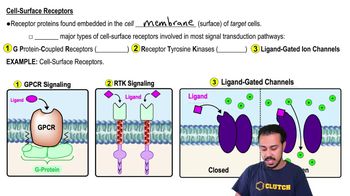
Cell Surface Receptors
Receptor proteins found embedded in the cell membrane.
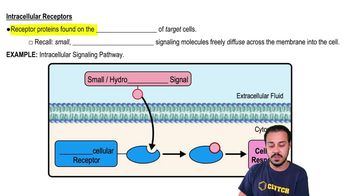
Intracellular Receptors
Receptor proteins found within the cell, interacting with small hydrophobic signaling molecules.
What are the two main classes of signaling receptors?
Cell surface receptors and intracellular receptors.
G Protein-Coupled Receptors (GPCRs)
A type of cell surface receptor that changes conformation when bound to a ligand.
Receptor Tyrosine Kinases (RTKs)
A type of cell surface receptor with two domains that phosphorylate tyrosine residues.
Ligand-Gated Ion Channels
Cell surface receptors that open to allow ions to pass through the membrane upon ligand binding.
What type of molecules interact with intracellular receptors?
Small hydrophobic signaling molecules.
Signal Transduction Pathways
Processes by which a cell converts an extracellular signal into a functional response.
What happens when a ligand binds to a GPCR?
The GPCR changes conformation and activates a G protein.
What is the role of RTKs in cellular signaling?
They phosphorylate tyrosine residues on themselves and other proteins to propagate the signal.
How do ligand-gated ion channels function?
They open to allow ions to flow through the membrane when a ligand binds.
What is the primary location of intracellular receptors?
Inside the cell, often in the cytoplasm or nucleus.
Hydrophobic Signaling Molecules
Molecules that can diffuse across the cell membrane to interact with intracellular receptors.
What is the main characteristic of cell surface receptors?
They are embedded in the cell membrane.
What triggers the opening of ligand-gated ion channels?
Binding of a specific ligand.
Conformation Change
A structural change in a receptor protein upon ligand binding.
What is the function of intracellular receptors?
To bind small hydrophobic molecules and trigger a cellular response.
Cell Membrane
The structure that cell surface receptors are embedded in.
What are the three major types of cell surface receptors?
GPCRs, RTKs, and ligand-gated ion channels.
Cytoplasm
The location within the cell where intracellular receptors are often found.
What does RTK stand for?
Receptor Tyrosine Kinase.
What does GPCR stand for?
G Protein-Coupled Receptor.
Extracellular Fluid
The fluid outside the cell where cell surface receptors interact with ligands.
What is the role of ligand binding in receptor function?
It induces a conformation change in the receptor, initiating a signal transduction pathway.
Plasma Membrane
Another term for the cell membrane where cell surface receptors are located.
What type of receptor is involved in most signal transduction pathways?
Cell surface receptors.
What is the primary function of signaling receptors?
To detect and respond to specific ligands or signaling molecules.
What is the difference between cell surface and intracellular receptors?
Cell surface receptors are embedded in the cell membrane, while intracellular receptors are found inside the cell.
What happens after a small hydrophobic molecule binds to an intracellular receptor?
It triggers a cascade of events leading to a cellular response.
 BackBack
 00:52
00:52