What type of information is used to direct different polypeptides to fold into different shapes?
Ch.3 - Protein Structure and Function
Chapter 3, Problem 1
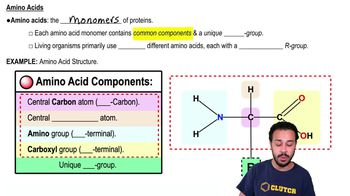
What two functional groups are bound to the central carbon of every free amino acid monomer?
a. an R-group and a hydroxyl group
b. an amino group and a hydroxyl group
c. an amino group and a carboxyl group
Verified step by step guidance1
Identify the central carbon in an amino acid, which is also known as the alpha carbon.
Recognize that each amino acid has a specific side chain known as an R-group attached to the central carbon.
Understand that in addition to the R-group, there are two other groups attached to the central carbon: an amino group and a carboxyl group.
Recall that the amino group is characterized by the presence of nitrogen (typically NH2), and the carboxyl group contains a double-bonded oxygen and an OH group (COOH).
Conclude that the correct answer must include both an amino group and a carboxyl group attached to the central carbon of every free amino acid monomer.

Verified video answer for a similar problem:
This video solution was recommended by our tutors as helpful for the problem above.
Video duration:
2mWas this helpful?
Key Concepts
Here are the essential concepts you must grasp in order to answer the question correctly.
Amino Acids
Amino acids are organic compounds that serve as the building blocks of proteins. Each amino acid consists of a central carbon atom (the alpha carbon) bonded to four different groups: an amino group, a carboxyl group, a hydrogen atom, and a variable R-group (side chain) that determines the specific properties of the amino acid.
Recommended video:
Guided course
Amino Acids
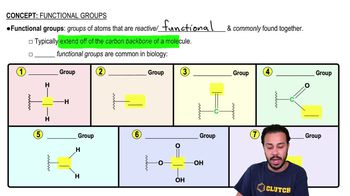
Functional Groups
Functional groups are specific groups of atoms within molecules that are responsible for the characteristic chemical reactions of those molecules. In amino acids, the two key functional groups are the amino group (-NH2), which acts as a base, and the carboxyl group (-COOH), which acts as an acid, allowing amino acids to participate in various biochemical processes.
Recommended video:
Guided course
Functional Groups
Peptide Bond Formation
Peptide bonds are covalent bonds that link amino acids together to form proteins. This bond forms between the carboxyl group of one amino acid and the amino group of another, releasing a molecule of water in a dehydration synthesis reaction. Understanding this process is crucial for grasping how amino acids combine to create polypeptides and ultimately proteins.
Recommended video:
Guided course
Ionic Bonds
Related Practice
Textbook Question
4
views
Textbook Question
What type of bond is directly involved in the formation of an α-helix?
a. Peptide bonds between amino acid residues
b. Hydrogen bonds between amino acid residues
c. Van der Waals interactions between nonpolar residues
d. Disulfide bonds between cysteine residues
6
views
2
rank
Textbook Question
Which of the following correctly describe an active site? Select True or False for each statement.
T/F It is the location in an enzyme where substrates bind.
T/F It is the place where a molecule or ion binds to an inactive enzyme to induce a shape change to make it active.
T/F It is the portion of an enzyme where chaperones bind to help enzymes fold.
T/F It is the site on an enzyme where catalysis occurs.
1
views