Which of the following is true of RNA processing? (A) Exons are cut out before mRNA leaves the nucleus. (B) Nucleotides are added at both ends of the RNA. (C) Ribozymes may function in the addition of a 5′ cap. (D) RNA splicing adds a poly-A tail to the mRNA.
Ch. 17 - Gene Expression: From Gene to Protein
Chapter 17, Problem 2
Which of the following is true of a codon?
a. It never codes for the same amino acid as another codon.
b. It can code for more than one amino acid.
c. It can be either in DNA or in RNA
d. It is the basic unit of protein structure
Verified step by step guidance1
Understand the definition of a codon: A codon is a sequence of three nucleotides in RNA that corresponds to a specific amino acid or a stop signal during protein synthesis.
Recall that codons are found in messenger RNA (mRNA) and are read during the process of translation to assemble amino acids into a polypeptide chain.
Analyze option (A): This is incorrect because multiple codons can code for the same amino acid due to the redundancy of the genetic code (e.g., both UUU and UUC code for phenylalanine).
Analyze option (B): This is incorrect because each codon specifies only one amino acid or a stop signal; codons do not code for multiple amino acids.
Analyze option (C): This is incorrect because codons are specifically found in RNA, not DNA. DNA contains triplets, which are transcribed into codons in RNA.

Verified video answer for a similar problem:
This video solution was recommended by our tutors as helpful for the problem above.
Video duration:
1mWas this helpful?
Key Concepts
Here are the essential concepts you must grasp in order to answer the question correctly.
Codon Definition
A codon is a sequence of three nucleotides in DNA or RNA that corresponds to a specific amino acid or a stop signal during protein synthesis. Codons are essential for translating genetic information into proteins, as they dictate the order in which amino acids are assembled.
Recommended video:
Guided course
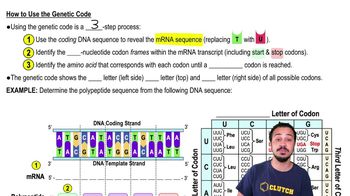
How to Use the Genetic Code
Genetic Code
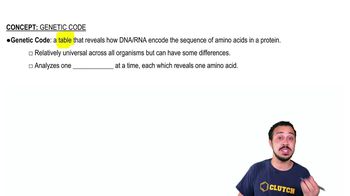
The genetic code is the set of rules by which information encoded in genetic material is translated into proteins. It is nearly universal among organisms and consists of 64 codons that specify 20 amino acids, allowing for redundancy where multiple codons can code for the same amino acid.
Recommended video:
Guided course
Genetic Code
Difference Between DNA and RNA Codons
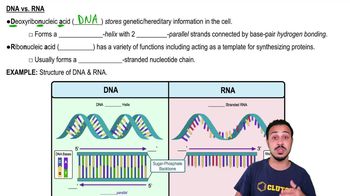
Codons can be found in both DNA and RNA, but they play different roles in the two types of nucleic acids. In DNA, codons are transcribed into mRNA, which then carries the genetic information to ribosomes for translation into proteins. This distinction is crucial for understanding the flow of genetic information.
Recommended video:
Guided course
DNA vs. RNA
Related Practice
Textbook Question
Textbook Question
In eukaryotic cells, transcription cannot begin until
a. The two DNA strands have completely separated and exposed the promoter.
b. Several transcription factors have bound to the promoter.
c. The 5′ caps are removed from the mRNA.
d. The DNA introns are removed from the template.
1
views
Textbook Question
The anticodon of a particular tRNA molecule is
a. Complementary to the corresponding mRNA codon
b. Complementary to the corresponding triplet in rRNA
c. The part of tRNA that bonds to a specific amino acid
d. Catalytic, making the tRNA a ribozyme
Textbook Question
Which component is directly involved in translation?
A. RNA polymerase
B. ribosome
C. spliceosome
D. DNA
