Skip to main content
Biochemistry
My Course
Learn
Exam Prep
AI Tutor
Study Guides
Flashcards
Explore
Try the app
My Course
Learn
Exam Prep
AI Tutor
Study Guides
Flashcards
Explore
Try the app
Back
Properties of Water definitions
You can tap to flip the card.
Polar Molecule
You can tap to flip the card.
👆
Polar Molecule
Has uneven charge distribution, resulting in partial positive and negative regions that enable strong interactions with other polar substances.
Track progress
Control buttons has been changed to "navigation" mode.
1/17
Related flashcards
Related practice
Recommended videos
Properties of Water quiz #1
Properties of Water
11 Terms
Properties of Water
2. Water
7 problems
Topic
Osmosis
2. Water
7 problems
Topic
2. Water - Part 1 of 3
4 topics
11 problems
Chapter
2. Water - Part 2 of 3
5 topics
11 problems
Chapter
2. Water - Part 3 of 3
4 topics
11 problems
Chapter
Guided course
05:05
Unique Properties of Water
11
views
Guided course
04:41
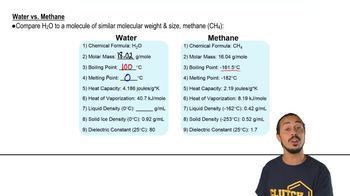
Water vs. Methane
9
views
Guided course
04:52
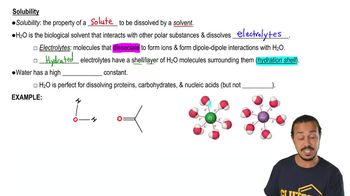
Water Solubility
10
views
Terms in this set (17)
Hide definitions
Polar Molecule
Has uneven charge distribution, resulting in partial positive and negative regions that enable strong interactions with other polar substances.
Bent Geometry
Describes the shape of a molecule where atoms are not arranged in a straight line, leading to unique physical and chemical properties.
Bond Angle
Measures the angle between two adjacent bonds in a molecule, influencing its overall shape and polarity.
Dipole Moment
Represents the separation of charge within a molecule, contributing to its polarity and ability to interact with other molecules.
Lone Pair
Refers to non-bonding electrons on an atom, affecting molecular shape and enabling formation of hydrogen bonds.
Hydrogen Bond
A strong intermolecular attraction involving a hydrogen atom and an electronegative atom, responsible for many unique properties.
Boiling Point
The temperature at which a substance transitions from liquid to gas, influenced by intermolecular forces like hydrogen bonding.
Melting Point
The temperature at which a substance transitions from solid to liquid, reflecting the strength of molecular interactions.
Heat Capacity
Indicates the amount of energy required to raise the temperature of a substance by one unit, linked to molecular structure.
Heat of Vaporization
Amount of energy needed to convert a liquid into a gas at its boiling temperature, highlighting the strength of intermolecular forces.
Density
Describes mass per unit volume, with water exhibiting decreased density upon freezing, allowing ice to float.
Surface Tension
Reflects the cohesive forces at a liquid's surface, enabling water to resist external force and form droplets.
Cohesion
Describes the attraction between molecules of the same substance, resulting in strong internal bonding in water.
Adhesion
Refers to the attraction between water molecules and other polar or charged substances, facilitating interactions with various materials.
Dielectric Constant
Quantifies a solvent's ability to diminish electrostatic interactions, making water highly effective at dissolving polar substances.
Hydration Shell
A layer of water molecules surrounding ions or polar molecules, stabilizing them and enhancing solubility.
Electrolyte
A substance that dissociates into ions in solution, enabling electrical conductivity and forming hydrated complexes in water.
 BackBack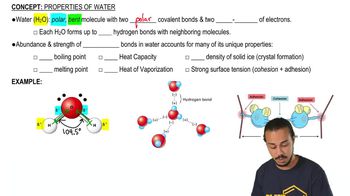
 05:05
05:05