Back

Types of Membrane Proteins definitions

Control buttons has been changed to "navigation" mode.
1/15
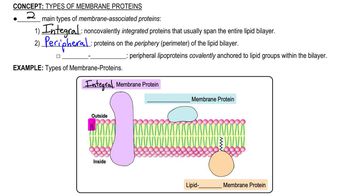
  • Integral Protein

    Non-covalently embedded structure spanning the entire phospholipid bilayer, possessing both extracellular and intracellular regions.
  • Peripheral Protein

    Structure located on the membrane surface, not spanning the bilayer, often interacting with other membrane components.
  • Lipid Bilayer

    Double-layered membrane matrix composed of phospholipids, providing a barrier and environment for protein integration.
  • Lipid-Linked Protein

    Peripheral structure covalently attached to lipid groups within the bilayer, forming a distinct membrane association.
  • Lipoprotein

    Protein covalently bonded to a lipid, often found on the membrane periphery, contributing to structural and functional diversity.
  • Extracellular Matrix

    Network outside the cell to which membrane proteins anchor, supporting cellular structure and communication.
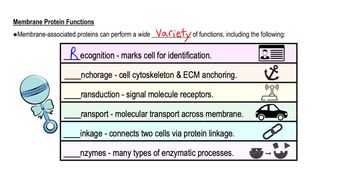
  • Recognition

    Function enabling cell identification, allowing immune cells to distinguish healthy from foreign cells.
  • Anchorage

    Function facilitating attachment of the cell or cytoskeleton to external structures, maintaining cellular stability.
  • Signal Transduction

    Process where membrane proteins relay signals between the cell's exterior and interior, enabling communication.
  • Transport

    Function allowing movement of molecules across the membrane, supporting cellular import and export.
  • Linkage

    Function connecting cells via protein interactions, promoting tissue integrity and cellular cooperation.
  • Enzymatic Activity

    Role in catalyzing chemical reactions at the membrane, accelerating diverse biochemical processes.
  • Facilitated Diffusion

    Mechanism where membrane proteins assist passive movement of molecules across the bilayer.
  • Cell Identification

    Capability of membrane proteins to mark cells, crucial for immune recognition and tissue organization.
  • Structural Integrity

    Contribution of membrane proteins to maintaining cell shape and resilience against external forces.