Back

Titrations of Amino Acids with Ionizable R-Groups quiz

Control buttons has been changed to "navigation" mode.
1/15
  • How many ionizable groups do amino acids with ionizable R groups have?

    They have three ionizable groups: the amino group, the carboxyl group, and the R group.
  • What is the main difference between the titration curves of amino acids with ionizable and non-ionizable R groups?

    Amino acids with ionizable R groups have three inflection and equivalence points, while those with non-ionizable R groups have only two.
  • What mnemonic can help you remember the seven amino acids with ionizable R groups?

    The mnemonic is 'yucky crazy dragons eat knights riding horses.'
  • Which amino acid is used as an example for titration curves with ionizable R groups in the lesson?

    Histidine is used as the example.
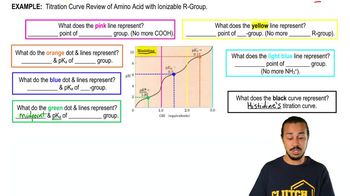
  • What does the green dot and line on histidine’s titration curve represent?

    They represent the midpoint and pKa of the carboxyl group, which is about 1.82.
  • What does the blue dot and line on histidine’s titration curve indicate?

    They indicate the midpoint and pKa of the R group.
  • What does the orange dot and line on histidine’s titration curve signify?

    They signify the midpoint and pKa of the amino group, which is about 9.17.
  • What does the pink vertical line at 1 molar equivalent of titrant represent?

    It represents the equivalence point for the carboxyl group, where the carboxyl group is fully deprotonated.
  • What does the yellow vertical line on the titration curve correspond to?

    It corresponds to the equivalence point for the R group, where the R group is fully deprotonated and uncharged.
  • What does the light blue vertical line at 3 molar equivalents of titrant indicate?

    It indicates the equivalence point for the amino group, where the amino group is fully deprotonated.
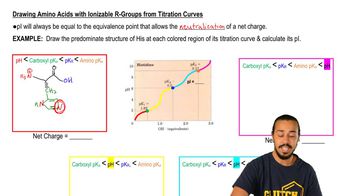
  • How do you determine the predominant structure of histidine at a given pH?

    You consider the protonation state of each ionizable group based on whether the pH is above or below their respective pKa values.
  • What is the net charge of histidine’s predominant structure at pH values less than all its pKa values?

    The net charge is +2, with all groups protonated.
  • What happens to the net charge of histidine as the pH increases and crosses each pKa?

    The net charge decreases by one each time a pKa is crossed, going from +2 to -1.
  • How is the isoelectric point (pI) of histidine calculated?

    The pI is calculated as the average of the two pKa values that sandwich the region where the net charge is zero.
  • What is the isoelectric point (pI) of histidine and which equivalence point does it correspond to?

    The pI of histidine is 7.59, and it corresponds to the equivalence point of the R group.