Back

Tandem Mass Spectrometry quiz

Control buttons has been changed to "navigation" mode.
1/15
  • What does 'tandem' refer to in tandem mass spectrometry (MS/MS)?

    It refers to using two mass spectrometers in sequence, one after the other.
  • What is a major advantage of tandem mass spectrometry over single mass spectrometry for protein analysis?

    Tandem MS can analyze both purified proteins and proteins within mixtures, reducing the need for extensive purification.
  • Why is tandem mass spectrometry considered a gold standard for protein sequencing?

    Because it provides a cleaner, simpler spectrum that is easier to analyze and interpret for sequencing.
  • How does tandem MS handle large proteins compared to single MS?

    Tandem MS can analyze large proteins by filtering and selecting specific peptide fragments, preventing overly complex spectra.
  • What is the first step in the tandem mass spectrometry process?

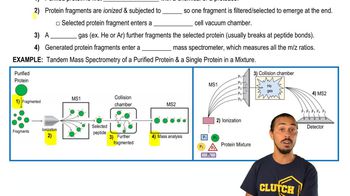
    The first step is fragmentation of the protein into smaller peptide pieces using chemicals or proteases.
  • What role does the first mass spectrometer (MS1) play in tandem MS?

    MS1 acts as a filter, selecting a specific peptide fragment to continue to the next stage.
  • What happens to the selected peptide fragment after it passes through MS1?

    It enters a collision chamber where it is further fragmented by collision with a noble gas like helium or argon.
  • What is the purpose of the collision chamber in tandem MS?

    The collision chamber further fragments the selected peptide by breaking peptide bonds using a noble gas.
  • What does the second mass spectrometer (MS2) do in tandem MS?

    MS2 performs mass analysis on the fragments generated in the collision chamber, producing a mass spectrum.
  • How does tandem MS simplify the resulting mass spectrum compared to single MS?

    By filtering and selecting specific fragments, tandem MS reduces the number of peaks, making the spectrum easier to analyze.
  • Can tandem MS analyze proteins directly from mixtures, and why is this beneficial?

    Yes, it can analyze proteins from mixtures, saving time by avoiding the need for complete purification.
  • What types of gases are commonly used in the collision chamber of tandem MS?

    Noble gases such as helium or argon are commonly used.
  • What is the main limitation of single mass spectrometry when analyzing proteins?

    Single MS is limited to small proteins or peptides because large proteins produce too many fragments, complicating the spectrum.
  • How does tandem MS allow for precise targeting within complex protein mixtures?

    It filters and selects specific peptide fragments for further analysis, enabling focus on proteins of interest.
  • What are the four main steps of tandem mass spectrometry?

    The steps are: protein fragmentation, ionization and initial mass filtering, further fragmentation by collision, and final mass analysis.