Back

Stimulatory Adenylate Cyclase GPCR Signaling definitions

Control buttons has been changed to "navigation" mode.
1/15
  • Epinephrine

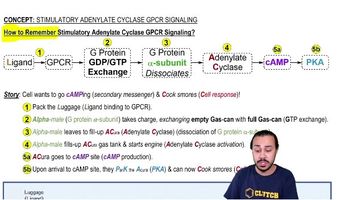
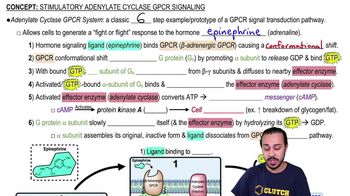
    Hormone that triggers emergency cellular responses by binding to specific membrane receptors.
  • Beta Adrenergic GPCR

    Membrane receptor specialized for adrenaline detection, initiating signal transduction.
  • Conformational Shift

    Structural change in a protein that enables downstream signaling events.
  • G Protein

    Membrane-associated heterotrimeric complex mediating signal relay after receptor activation.
  • Alpha Subunit

    Component of a G protein responsible for activating effector enzymes upon GTP binding.
  • GDP

    Low-energy nucleotide bound to inactive G proteins before signal initiation.
  • GTP

    High-energy nucleotide that activates G protein alpha subunits for signal propagation.
  • Adenylate Cyclase

    Effector enzyme converting ATP into a key secondary messenger during signal transduction.
  • ATP

    Cellular energy molecule serving as substrate for secondary messenger synthesis.
  • cAMP

    Secondary messenger amplifying signals and activating downstream kinases in cells.
  • Protein Kinase A

    Enzyme activated by cAMP, responsible for phosphorylating targets to elicit cellular responses.
  • Signal Transduction

    Process by which extracellular cues are converted into intracellular actions via molecular cascades.
  • Fight or Flight Response

    Cellular and physiological changes preparing organisms for rapid action during emergencies.
  • Effector Enzyme

    Protein activated by signaling molecules to generate secondary messengers.
  • Secondary Messenger

    Intracellular molecule produced in response to external signals, amplifying and distributing the signal.