Back

SDS-PAGE Strategies quiz

Control buttons has been changed to "navigation" mode.
1/15
  • What property does SDS-PAGE use to separate proteins?

    SDS-PAGE separates proteins based solely on their mass.
  • What must be added to SDS-PAGE to separate protein subunits linked by disulfide bonds?

    A reducing agent like beta-mercaptoethanol (BME) must be added to cleave disulfide bonds.
  • What does beta-mercaptoethanol (BME) do in SDS-PAGE?

    BME cleaves covalent disulfide bonds, allowing previously linked subunits to separate.
  • How does native PAGE differ from SDS-PAGE in terms of protein separation?

    Native PAGE separates proteins based on shape, mass, and charge, while SDS-PAGE separates only by mass.
  • What happens to protein subunits in SDS-PAGE if they are not covalently linked?

    They separate and appear as individual bands based on their size.
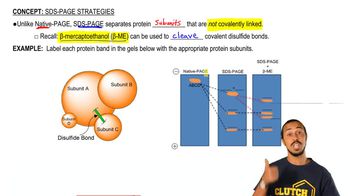
  • Why do subunits A and C migrate together in SDS-PAGE without BME?

    They are covalently linked by a disulfide bond, which SDS alone does not break.
  • What is the effect of SDS on protein structure?

    SDS denatures proteins, giving them a uniform negative charge and linear shape.
  • Which protein subunit migrates the slowest in SDS-PAGE?

    The largest subunit or combined subunits migrate the slowest.
  • What three factors influence protein migration in native PAGE?

    Shape, mass, and charge influence migration in native PAGE.
  • After treating with BME and SDS, how are subunits A and C visualized on the gel?

    They appear as separate bands because the disulfide bond linking them is broken.
  • What does a single band in native PAGE represent for a protein with multiple subunits?

    It represents the intact protein complex with all its subunits together.
  • Why do larger protein subunits migrate slower in SDS-PAGE?

    Larger subunits experience more resistance in the gel matrix, so they move slower.
  • What is the role of SDS in SDS-PAGE?

    SDS denatures proteins and coats them with negative charge, ensuring separation is based on size.
  • How can SDS-PAGE with BME help analyze protein structure?

    It allows identification of individual subunits and their sizes by separating covalently linked subunits.
  • What does the appearance of an additional band after BME treatment indicate?

    It indicates that a disulfide bond was present and has been cleaved, releasing a previously linked subunit.