Back

Rate Constants and Rate Law quiz

Control buttons has been changed to "navigation" mode.
1/15
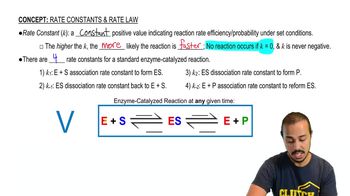
  • What does the rate constant (k) represent in a chemical reaction?

    The rate constant (k) represents the reaction rate efficiency or probability under specific conditions; a higher k means a faster reaction.
  • Which rate constant describes the association of free enzyme and substrate to form the enzyme-substrate complex?

    The association of free enzyme and substrate to form the enzyme-substrate complex is described by k1.
  • What does the rate constant k-1 represent in enzyme-catalyzed reactions?

    k-1 is the dissociation rate constant for the enzyme-substrate complex breaking back into free enzyme and substrate.
  • Which rate constant is responsible for the formation of product from the enzyme-substrate complex?

    k2 is the rate constant for the dissociation of the enzyme-substrate complex to form the product and free enzyme.
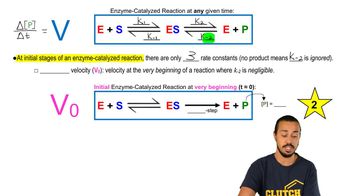
  • Why can k-2 be ignored during the initial stages of an enzyme-catalyzed reaction?

    k-2 can be ignored because, at the very beginning, the product concentration is zero, so the reverse reaction (product + enzyme reforming the complex) cannot occur.
  • What is the initial reaction velocity (v₀) and when is it measured?

    The initial reaction velocity (v₀) is the reaction rate measured at the very beginning of the reaction, when product concentration is zero.
  • How is the reaction rate (v) typically expressed in terms of product concentration and time?

    The reaction rate (v) is expressed as the change in product concentration divided by the change in time (Δ[Product]/Δt).
  • What is the rate law and what variables does it relate?

    The rate law is a mathematical relationship that relates the reaction rate (v) to the rate constant (k) and the initial concentrations of reactants.
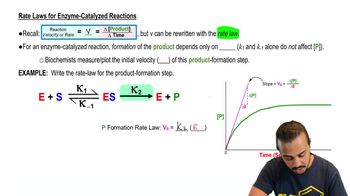
  • For enzyme-catalyzed reactions, which rate constant primarily determines the rate of product formation?

    k2 primarily determines the rate of product formation, as it is the rate-limiting step in the reaction.
  • Why do biochemists focus on the initial reaction velocity when studying enzyme kinetics?

    Biochemists focus on the initial reaction velocity because only one rate constant (k2) affects product formation, simplifying analysis.
  • How do you write the rate law for a simple reaction where A is converted to B?

    The rate law is v = k[A]^1, where k is the rate constant and [A] is the concentration of reactant A raised to the reaction order (often 1).
  • What does the reaction order in the rate law typically correspond to in simple reactions?

    The reaction order often corresponds to the coefficient of the reactant in the balanced chemical equation.
  • In the context of enzyme-catalyzed reactions, which reactant's concentration is used in the rate law for the product formation step?

    The concentration of the enzyme-substrate complex is used in the rate law for the product formation step.
  • What does the slope of the tangent line at early time points on a product vs. time graph represent?

    The slope of the tangent line at early time points represents the initial reaction velocity (v₀).
  • Why are k1 and k-1 not considered when measuring the change in product concentration during the initial reaction velocity?

    k1 and k-1 only affect the formation and dissociation of the enzyme-substrate complex, not the direct formation of product.