Back

Protein-Ligand Fractional Saturation quiz

Control buttons has been changed to "navigation" mode.
1/15
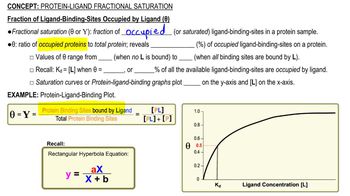
  • What does the variable theta (θ) or capital Y (Y) represent in protein-ligand interactions?

    Theta or Y represents the fractional saturation, which is the fraction of occupied ligand binding sites on a protein.
  • How is fractional saturation (θ or Y) mathematically defined?

    It is defined as the ratio of the concentration of ligand-bound protein to the total protein concentration (bound plus free protein).
  • What is the maximum possible value for fractional saturation (θ) and what does it indicate?

    The maximum value is 1, indicating that 100% of ligand binding sites are occupied.
  • What does a θ value of 0 mean in the context of protein-ligand binding?

    A θ value of 0 means that none of the ligand binding sites on the protein are occupied.
  • What is the dissociation equilibrium constant (Kd) in protein-ligand binding?

    Kd is the ligand concentration at which 50% of the available binding sites are occupied (θ = 0.5).
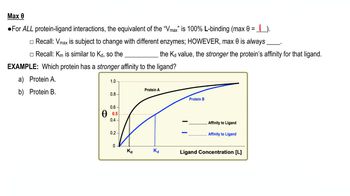
  • How does the value of Kd relate to the affinity of a protein for its ligand?

    A smaller Kd indicates a stronger affinity of the protein for the ligand.
  • On a saturation curve, what is plotted on the y-axis and x-axis?

    The y-axis plots fractional saturation (θ or Y), and the x-axis plots ligand concentration.
  • What does the shape of the protein-ligand saturation curve resemble?

    It resembles a rectangular hyperbola, similar to the Michaelis-Menten curve.
  • If two proteins have the same maximum θ but different Kd values, which has the stronger ligand affinity?

    The protein with the smaller Kd value has the stronger ligand affinity.
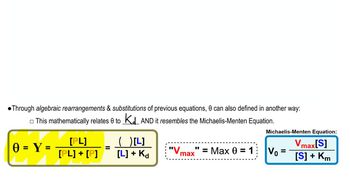
  • How can the fractional saturation equation be rearranged to relate θ to Kd and ligand concentration?

    Through algebraic rearrangement, θ can be expressed in a form similar to the Michaelis-Menten equation, relating θ to Kd and ligand concentration.
  • What is the equivalent of Vmax in protein-ligand binding saturation curves?

    The equivalent of Vmax is the maximum fractional saturation, which is always 1 (100% binding).
  • Why is the maximum θ value always 1 for protein-ligand interactions?

    Because you cannot have more than 100% of binding sites occupied; all sites bound corresponds to θ = 1.
  • What does a θ value of 0.5 correspond to in terms of ligand concentration?

    It corresponds to the ligand concentration equal to the Kd value.
  • How does the Michaelis constant (Km) relate to Kd in the context of protein-ligand binding?

    Km is conceptually similar to Kd; both represent the concentration at which half-maximal binding or activity occurs.
  • What is the practical significance of knowing the Kd value for a protein-ligand interaction?

    Knowing Kd allows you to determine the ligand concentration needed for half of the binding sites to be occupied, reflecting the protein's binding affinity.