Back

Protein-Ligand Equilibrium Constants quiz

Control buttons has been changed to "navigation" mode.
1/15
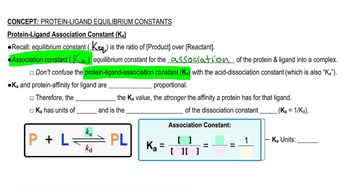
  • What does the association equilibrium constant (K_a) measure in protein-ligand interactions?

    K_a measures the affinity of a protein for a ligand; a higher K_a indicates stronger affinity.
  • How are the units of K_a and K_d different?

    K_a has units of inverse molarity (1/M), while K_d has units of molarity (M).
  • What is the mathematical relationship between K_a and K_d?

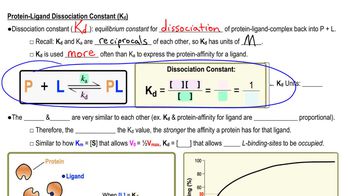
    K_a and K_d are reciprocals of each other; K_a = 1/K_d and K_d = 1/K_a.
  • Why is K_d used more frequently than K_a to express protein-ligand affinity?

    K_d is used more often because its units (molarity) are easier to interpret and it resembles the Michaelis constant (K_m).
  • What does K_d represent in terms of ligand concentration and binding sites?

    K_d represents the ligand concentration at which 50% of the protein binding sites are occupied.
  • How does the value of K_a relate to protein-ligand affinity?

    K_a is directly proportional to affinity; a higher K_a means stronger protein-ligand binding.
  • How does the value of K_d relate to protein-ligand affinity?

    K_d is inversely proportional to affinity; a lower K_d means stronger protein-ligand binding.
  • What is the difference between equilibrium constants and rate constants in protein-ligand interactions?

    Equilibrium constants (K_a, K_d) describe the ratio of products to reactants at equilibrium, while rate constants (k_a, k_d) describe the speed of association or dissociation.
  • How can K_a be expressed in terms of rate constants?

    K_a can be expressed as the ratio of the association rate constant (k_a) to the dissociation rate constant (k_d): K_a = k_a / k_d.
  • How can K_d be expressed in terms of rate constants?

    K_d can be expressed as the ratio of the dissociation rate constant (k_d) to the association rate constant (k_a): K_d = k_d / k_a.
  • What is the product and what are the reactants in the equilibrium expression for K_a?

    The product is the protein-ligand complex (PL), and the reactants are the free protein (P) and free ligand (L).
  • What is the product and what are the reactants in the equilibrium expression for K_d?

    The products are the free protein (P) and free ligand (L), and the reactant is the protein-ligand complex (PL).
  • Why should you not confuse the protein-ligand association constant K_a with the acid dissociation constant K_a?

    Both use the symbol K_a, but the protein-ligand K_a measures binding affinity, while the acid dissociation K_a measures acid strength.
  • How is K_d similar to the Michaelis constant (K_m) in enzyme kinetics?

    Both K_d and K_m represent the concentration of ligand or substrate at which half of the binding sites or enzyme active sites are occupied.
  • If the ligand concentration equals K_d, what percentage of protein binding sites are occupied?

    When ligand concentration equals K_d, 50% of the protein binding sites are occupied.