Back

Physical Properties of Biological Membranes quiz

Control buttons has been changed to "navigation" mode.
1/15
  • What is lateral diffusion in biological membranes?

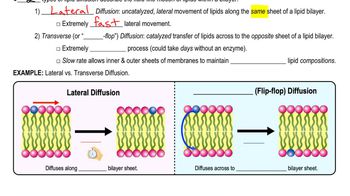
    Lateral diffusion is the rapid, uncatalyzed side-to-side movement of lipids within the same layer of the lipid bilayer.
  • How does transverse diffusion differ from lateral diffusion?

    Transverse diffusion, or flip-flop, moves lipids between the two layers of the bilayer and is much slower and requires enzymes, unlike the fast, uncatalyzed lateral diffusion.
  • Which enzymes catalyze transverse diffusion in membranes?

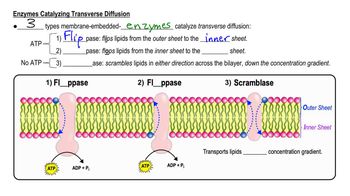
    Flippase, floppase, and scramblase are the three main enzymes that catalyze transverse diffusion.
  • What is the role of flippase in lipid bilayers?

    Flippase moves specific lipids from the outer sheet to the inner sheet of the membrane and requires ATP.
  • What does floppase do in the membrane?

    Floppase transfers lipids from the inner sheet to the outer sheet of the membrane, also using ATP.
  • How does scramblase function differently from flippase and floppase?

    Scramblase moves lipids in both directions across the bilayer down their concentration gradients and does not require ATP.
  • Why is transverse diffusion without enzymes extremely slow?

    Without enzymes, transverse diffusion can take days because the process is energetically unfavorable and not catalyzed.
  • What is the transition temperature (Tm) of a membrane?

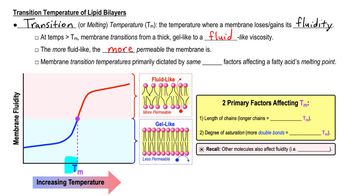
    The transition temperature (Tm) is the specific temperature at which a membrane shifts between a gel-like state and a fluid-like state.
  • How does membrane fluidity change above and below the transition temperature?

    Above the Tm, membranes become more fluid and permeable; below the Tm, they become gel-like and less permeable.
  • What are the two main factors that affect the transition temperature of a membrane?

    The two main factors are the length of the fatty acid chains and the degree of saturation (number of double bonds) in the phospholipids.
  • How does fatty acid chain length affect the transition temperature?

    Longer fatty acid chains increase the transition temperature, making the membrane less fluid at a given temperature.
  • What effect do double bonds in fatty acids have on membrane Tm?

    More double bonds (greater unsaturation) lower the transition temperature, increasing membrane fluidity.
  • How do proteins and cholesterol affect membrane fluidity?

    Proteins and cholesterol embedded in the membrane can also influence its fluidity and permeability.
  • Why is the slow rate of uncatalyzed transverse diffusion important for membrane composition?

    It allows the inner and outer layers of the membrane to maintain different lipid compositions.
  • How can cells control the fluidity and permeability of their membranes?

    Cells can adjust the fatty acid chain length, degree of saturation, and the presence of other molecules like proteins and cholesterol in the membrane.