Back

Edman Degradation quiz

Control buttons has been changed to "navigation" mode.
1/15
  • What is the main purpose of Edman degradation in protein analysis?

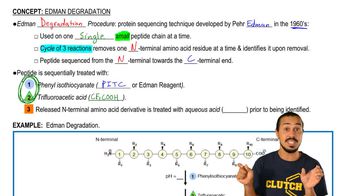
    Edman degradation is used to sequence proteins by identifying the N-terminal amino acid of a small polypeptide chain, one residue at a time.
  • Which scientist developed the Edman degradation technique and in what decade?

    Per Edman developed the Edman degradation technique in the 1960s.
  • Why must the peptide used in Edman degradation be relatively small?

    The peptide must be small because the reaction efficiency decreases with larger peptides, making sequencing less accurate.
  • What is the first reagent used in the Edman degradation cycle?

    The first reagent is phenyl isothiocyanate (PITC), also known as the Edman reagent.
  • Under what pH conditions does the reaction with phenyl isothiocyanate occur?

    The reaction with phenyl isothiocyanate occurs under basic conditions, typically at pH 9.
  • What is the second reagent used in Edman degradation, and what is its chemical formula?

    The second reagent is trifluoroacetic acid, with the chemical formula CF3COOH.
  • What happens to the N-terminal amino acid after treatment with the first two reagents?

    The N-terminal amino acid is released from the peptide chain as an amino acid derivative.
  • What is the third reagent used in Edman degradation, and what is its purpose?

    The third reagent is aqueous acid (H3O+), which converts the released amino acid derivative into a stable PTH-amino acid.
  • What does PTH stand for in the context of Edman degradation?

    PTH stands for phenylthiohydantoin, which is the stable derivative of the N-terminal amino acid.
  • How is the PTH-amino acid identified after its formation?

    The PTH-amino acid is identified using high performance liquid chromatography (HPLC).
  • In Edman degradation, from which end of the peptide is sequencing performed?

    Sequencing is performed from the N-terminal end toward the C-terminal end.
  • What is revealed after one complete cycle of Edman degradation?

    One cycle reveals the identity of a single N-terminal amino acid residue.
  • What must be done to sequence the entire peptide using Edman degradation?

    The Edman degradation cycle must be repeated for each residue until the full peptide sequence is determined.
  • What is the final product analyzed to identify the N-terminal amino acid in Edman degradation?

    The final product is the PTH-amino acid, which is analyzed to identify the N-terminal residue.
  • Why is Edman degradation sometimes called N-terminal peptide sequencing?

    It is called N-terminal peptide sequencing because it sequentially removes and identifies amino acids starting from the N-terminal end.