Skip to main content
Biochemistry
My Course
Learn
Exam Prep
AI Tutor
Study Guides
Flashcards
Explore
Try the app
My Course
Learn
Exam Prep
AI Tutor
Study Guides
Flashcards
Explore
Try the app
Back
Amino Acid Groups definitions
You can tap to flip the card.
Amino Acid
You can tap to flip the card.
👆
Amino Acid
Organic molecule with a central carbon, amino group, carboxyl group, hydrogen, and unique R group; building block of proteins.
Track progress
Control buttons has been changed to "navigation" mode.
1/15
Related flashcards
Related practice
Recommended videos
Amino Acid Groups quiz #1
Amino Acid Groups
40 Terms
Amino Acid Groups quiz #2
Amino Acid Groups
40 Terms
Amino Acid Groups quiz #3
Amino Acid Groups
40 Terms
Amino Acid Groups
3. Amino Acids
7 problems
Topic
Amino Acid Three Letter Code
3. Amino Acids
6 problems
Topic
3. Amino Acids - Part 1 of 3
5 topics
15 problems
Chapter
3. Amino Acids - Part 2 of 3
5 topics
14 problems
Chapter
3. Amino Acids - Part 3 of 3
7 topics
16 problems
Chapter
Guided course
02:30
Amino Acid Groups
6
views
Guided course
04:57
Amino Acid Groups
3
views
Terms in this set (15)
Hide definitions
Amino Acid
Organic molecule with a central carbon, amino group, carboxyl group, hydrogen, and unique R group; building block of proteins.
R Group
Variable side chain attached to the central carbon in amino acids, determining chemical properties and group classification.
Alpha Carbon
Central atom in amino acids bonded to hydrogen, amino group, carboxyl group, and R group; core of amino acid structure.
Dipolar Ion
Molecule with both positive and negative charges at physiological pH, as seen in amino acid backbones.
Physiological pH
pH value around 7, typical of biological systems, where amino acids exist as dipolar ions.
Amino Group
Functional group with a positive charge at physiological pH, attached to the alpha carbon in amino acids.
Carboxyl Group
Functional group with a negative charge at physiological pH, attached to the alpha carbon in amino acids.
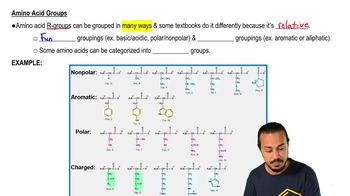
Functional Grouping
Classification system based on the biological function or behavior of amino acid R groups.
Structural Grouping
Classification system based on the arrangement and presence of atoms in amino acid R groups.
Non-Polar Amino Acid
Type of amino acid with R groups lacking polarity, grouped by functional properties.
Polar Amino Acid
Type of amino acid with R groups exhibiting polarity, grouped by functional properties.
Charged Amino Acid
Type of amino acid with R groups carrying a net positive or negative charge at physiological pH.
Aromatic Amino Acid
Type of amino acid with R groups containing aromatic rings, grouped by structural characteristics.
Abbreviation
Shortened form, either three-letter or one-letter, used to represent individual amino acids.
Protein
Macromolecule composed of amino acid chains, essential for biological structure and function.
 BackBack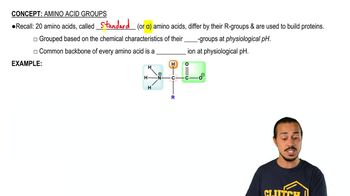
 02:30
02:30