Skip to main content
Biochemistry
My Course
Learn
Exam Prep
AI Tutor
Study Guides
Flashcards
Explore
Try the app
My Course
Learn
Exam Prep
AI Tutor
Study Guides
Flashcards
Explore
Try the app
Back
Osmosis quiz
You can tap to flip the card.
What is osmosis?
You can tap to flip the card.
👆
What is osmosis?
Osmosis is the diffusion of water across a semipermeable membrane from areas of high water concentration to low water concentration.
Track progress
Control buttons has been changed to "navigation" mode.
1/15
Related flashcards
Related practice
Recommended videos
Osmosis definitions
Osmosis
15 Terms
Osmosis
2. Water
7 problems
Topic
Hydrophobic Effect
2. Water
7 problems
Topic
2. Water - Part 1 of 3
4 topics
11 problems
Chapter
2. Water - Part 2 of 3
5 topics
11 problems
Chapter
2. Water - Part 3 of 3
4 topics
11 problems
Chapter
Guided course
04:19
Osmosis and Tonicity
6
views
Guided course
06:02
Results of Osmosis
6
views
Guided course
04:19
Osmosis Direction
8
views
Terms in this set (15)
Hide definitions
What is osmosis?
Osmosis is the diffusion of water across a semipermeable membrane from areas of high water concentration to low water concentration.
How does osmosis differ from general diffusion?
Osmosis specifically refers to the movement of water, while diffusion can involve any substance moving from high to low concentration.
What is a semipermeable membrane?
A semipermeable membrane allows some substances to cross while preventing others from crossing.
What is osmotic pressure?
Osmotic pressure is the pressure required to prevent the flow of water during osmosis and measures the strength of osmosis.
What does tonicity refer to?
Tonicity refers to the relative concentrations of solutes dissolved in solutions, not the solvent concentration.
What is an isotonic solution?
An isotonic solution has the same solute concentration as another solution, resulting in equal water flow in both directions.
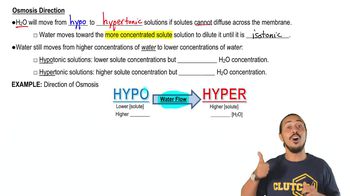
What is a hypotonic solution?
A hypotonic solution has a lower solute concentration and higher water concentration compared to another solution.
What is a hypertonic solution?
A hypertonic solution has a higher solute concentration and lower water concentration compared to another solution.
In which direction does water move during osmosis?
Water always moves from hypotonic solutions toward hypertonic solutions across a semipermeable membrane.
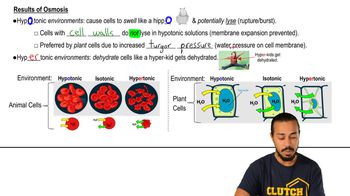
What happens to animal cells in a hypotonic environment?
Animal cells swell and may lyse (burst) because water flows into the cell from the hypotonic environment.
Why do plant cells not lyse in hypotonic solutions?
Plant cells have cell walls that prevent membrane expansion, so they gain turgor pressure instead of lysing.
What is turgor pressure?
Turgor pressure is the water pressure pushing the cell membrane against the cell wall, helping plants maintain their structure.
What happens to cells in a hypertonic environment?
Cells lose water, dehydrate, and shrink because water moves out of the cell toward the hypertonic environment.
Which environment is preferred by animal cells?
Animal cells prefer isotonic environments, where water flows equally in and out, maintaining cell size and function.
Which environment is preferred by plant cells and why?
Plant cells prefer hypotonic environments because increased turgor pressure helps them maintain their structure.
 BackBack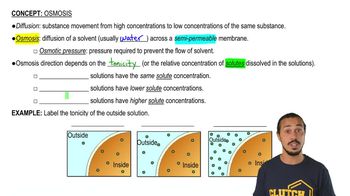
 04:19
04:19