Back

Nucleic Acids definitions

Control buttons has been changed to "navigation" mode.
1/15
  • Nucleic Acid

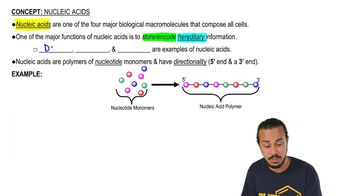
    One of four major biological macromolecules, responsible for storing and encoding hereditary information in cells.
  • DNA

    A double-stranded molecule forming a double helix, primarily encoding hereditary information and containing millions of nucleotides.
  • RNA

    A single-stranded molecule with diverse functions, including protein synthesis and catalysis, and typically smaller than DNA.
  • Nucleotide

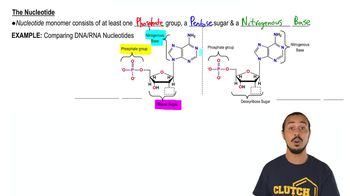
    A monomer unit of nucleic acids, composed of a phosphate group, a pentose sugar, and a nitrogenous base.
  • Phosphate Group

    A component of nucleotides, contributing to the backbone of nucleic acid polymers and providing negative charge.
  • Pentose Sugar

    A five-carbon sugar found in nucleotides; ribose in RNA and deoxyribose in DNA, determining the type of nucleic acid.
  • Nitrogenous Base

    A molecule in nucleotides, classified as purines or pyrimidines, enabling base pairing and genetic coding.
  • Purine

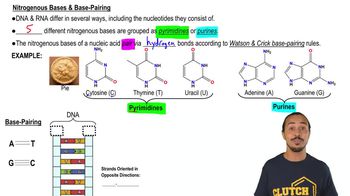
    A nitrogenous base with a double ring structure; includes adenine and guanine, found in both DNA and RNA.
  • Pyrimidine

    A nitrogenous base with a single ring structure; includes cytosine, thymine, and uracil.
  • Adenine

    A purine base that pairs with thymine in DNA and with uracil in RNA, forming two hydrogen bonds.
  • Thymine

    A pyrimidine base found in DNA, pairs with adenine via two hydrogen bonds; replaced by uracil in RNA.
  • Uracil

    A pyrimidine base found in RNA, replacing thymine and pairing with adenine.
  • Cytosine

    A pyrimidine base that pairs with guanine in both DNA and RNA, forming three hydrogen bonds.
  • Guanine

    A purine base that pairs with cytosine, forming three hydrogen bonds in nucleic acids.
  • Antiparallel

    A structural feature of DNA where two strands run in opposite directions, from 5' to 3' and 3' to 5'.