Back

Insulin Signaling on Glucose Metabolism definitions

Control buttons has been changed to "navigation" mode.
1/14
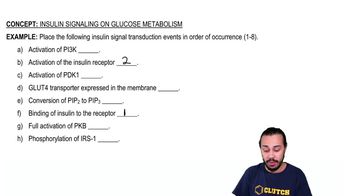
  • Insulin Receptor

    A membrane protein with tyrosine kinase activity that initiates signaling upon hormone binding, leading to glucose uptake and storage.
  • Tyrosine Kinase

    An enzyme domain that transfers phosphate groups to tyrosine residues, crucial for activating downstream signaling proteins.
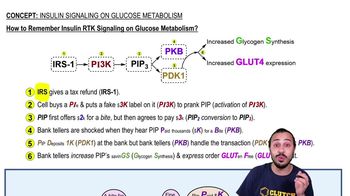
  • Insulin Receptor Substrate 1

    An adapter protein phosphorylated at tyrosine residues, serving as a bridge to recruit and activate other signaling enzymes.
  • Phosphoinositide 3-Kinase

    A kinase activated by binding to phosphorylated adapter proteins, catalyzing the conversion of membrane lipids to signaling molecules.
  • PIP2

    A membrane-bound phospholipid acting as a substrate for kinases, converted to a triphosphate form during insulin signaling.
  • PIP3

    A membrane lipid with three phosphate groups, generated from its diphosphate precursor, serving as a docking site for kinases.
  • Protein Kinase B

    A cytosolic kinase, also known as AKT, activated by phosphorylation and membrane association, regulating glucose transport and storage.
  • PDK1

    A kinase dependent on membrane lipids for activation, responsible for phosphorylating and activating downstream kinases.
  • GLUT4

    A glucose transporter whose expression in the plasma membrane increases in response to signaling, facilitating cellular glucose uptake.
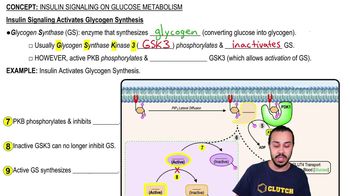
  • Glycogen Synthase

    An enzyme responsible for converting free glucose into storage polysaccharide, regulated by phosphorylation status.
  • Glycogen Synthase Kinase 3

    A kinase that phosphorylates and inactivates the enzyme responsible for glycogen formation, itself regulated by upstream signals.
  • Glycogen Synthesis

    The cellular process of assembling glucose molecules into a storage polymer, promoted by insulin signaling.
  • Blood Glucose Concentration

    The level of glucose in the bloodstream, tightly regulated by hormonal signaling and cellular uptake mechanisms.
  • SH2 Domain

    A protein region that specifically binds phosphorylated tyrosine residues, enabling recruitment of signaling enzymes.