Back

Indirect Protein Sequencing Via Geneomic Analyses quiz

Control buttons has been changed to "navigation" mode.
1/15
  • Why is indirect protein sequencing via genomic analyses preferred over direct protein sequencing methods?

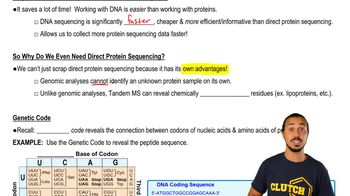
    It is faster, cheaper, and more efficient because DNA is more stable and easier to work with than proteins.
  • What is a major limitation of direct protein sequencing compared to genomic analyses?

    Direct protein sequencing only provides the amino acid sequence, while genomic analyses provide both nucleotide and derived amino acid sequences.
  • Why can't genomic analyses completely replace direct protein sequencing?

    Genomic analyses cannot identify unknown protein samples or detect chemically modified amino acids, which direct protein sequencing can do.
  • What is the main advantage of working with DNA over proteins in the lab?

    DNA is more stable and resistant to denaturation from temperature and pH changes, making it easier to handle.
  • How does the genetic code facilitate indirect protein sequencing?

    The genetic code translates mRNA codons into amino acids, allowing the derivation of protein sequences from nucleotide sequences.
  • What process converts a DNA coding sequence into an mRNA sequence?

    Transcription converts a DNA coding sequence into an mRNA sequence.
  • What nucleotide is present in mRNA instead of thymine?

    Uracil (U) replaces thymine (T) in mRNA.
  • How are mRNA sequences read during translation?

    mRNA sequences are read in sets of three nucleotides called codons.
  • What amino acid does the AUG codon code for?

    AUG codes for methionine, which is usually the first amino acid in a peptide.
  • Why is direct protein sequencing necessary for detecting chemically modified amino acids?

    Because genomic analyses cannot reveal post-translational modifications, but direct protein sequencing can.
  • What is the relationship between codons and amino acids?

    Each codon, a sequence of three nucleotides, corresponds to a specific amino acid according to the genetic code.
  • What is the sequence of steps to derive a peptide sequence from a gene?

    First, transcribe DNA to mRNA, then translate mRNA codons into amino acids using the genetic code.
  • What is one reason genomic analyses are more informative than direct protein sequencing?

    Genomic analyses provide both the nucleotide and the derived amino acid sequence, offering more comprehensive data.
  • What is required to perform genomic analyses for protein sequencing?

    A DNA sample is required to perform genomic analyses.
  • What is the indirect method of sequencing peptides described in the lesson?

    It involves sequencing DNA, transcribing it to mRNA, and then translating the mRNA to determine the peptide sequence.