Back

Abiogenesis definitions

Control buttons has been changed to "navigation" mode.
1/16
  • Abiogenesis

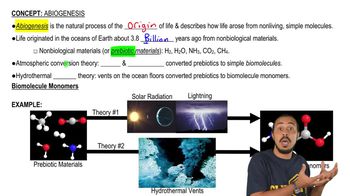
    Natural process describing the emergence of life from nonliving molecules on early Earth, occurring about 3.8 billion years ago.
  • Prebiotic Materials

    Non-biological molecules such as hydrogen gas, water, ammonia, carbon dioxide, and methane abundant on early Earth.
  • Atmosphere Conversion

    Theory proposing solar radiation and lightning converted prebiotic molecules into the first simple biomolecules.
  • Hydrothermal Vents

    Deep-sea locations providing energy for biomolecule formation where sunlight and lightning cannot penetrate.
  • Biomolecule Monomers

    Simple molecular units, like amino acids, formed from prebiotic materials and serving as building blocks for polymers.
  • Biomolecule Polymers

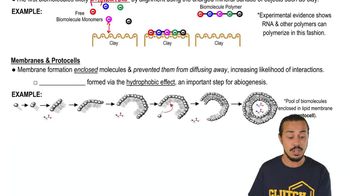
    Complex molecules created by linking monomers, often through alignment on charged mineral surfaces.
  • Charged Mineral Surfaces

    Positively or negatively charged substrates, such as clay, facilitating the alignment and bonding of biomolecule monomers.
  • Membrane Formation

    Process enclosing biomolecules, preventing their diffusion and increasing interaction likelihood, crucial for early life.
  • Hydrophobic Effect

    Phenomenon causing lipid molecules to aggregate in aqueous environments, leading to membrane creation.
  • Phospholipid Membrane

    Structure formed by phospholipids clustering in water, enclosing biomolecules and enabling protocell development.
  • Protocell

    Primitive, membrane-bound structure containing biomolecules, acting as a precursor to true cells.
  • Double Origin Theory

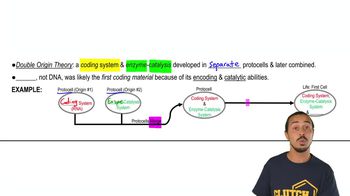
    Hypothesis suggesting life began with two separate systems: coding and enzyme catalysis, each in distinct protocells.
  • Coding System

    Molecular mechanism for storing and transmitting genetic information, initially based on RNA.
  • Enzyme Catalysis System

    System relying on protein enzymes to accelerate biochemical reactions, distinct from RNA catalysis.
  • RNA

    Molecule believed to be the first coding material, capable of both information storage and catalytic activity.
  • DNA

    Genetic material that appeared later, specializing in information storage but lacking catalytic functions.