Back

Hemoglobin Carbonation & Protonation quiz

Control buttons has been changed to "navigation" mode.
1/15
  • What is carbaminohemoglobin (HbCO2)?

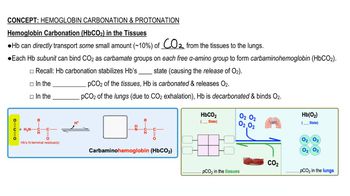
    Carbaminohemoglobin is hemoglobin with carbon dioxide bound as carbamate groups to its free alpha amino groups.
  • How many CO2 molecules can one hemoglobin molecule transport via carbonation?

    One hemoglobin molecule can transport up to four CO2 molecules, one per subunit.
  • Where does hemoglobin carbonation primarily occur?

    Hemoglobin carbonation primarily occurs in the tissues, not in the lungs.
  • What effect does hemoglobin carbonation have on hemoglobin's state?

    Hemoglobin carbonation stabilizes the T (tense) state, leading to the release of oxygen.
  • What happens to hemoglobin in the lungs regarding CO2 binding?

    In the lungs, hemoglobin releases CO2 due to low CO2 partial pressure and transitions to the R (relaxed) state.
  • What is hemoglobin protonation abbreviated as?

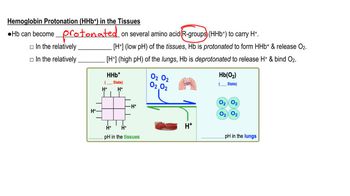
    Hemoglobin protonation is abbreviated as HHb+.
  • Where does hemoglobin protonation occur?

    Hemoglobin protonation occurs in the tissues, not in the lungs.
  • Which groups on hemoglobin are protonated during protonation?

    Protonation occurs at multiple amino acid R groups on hemoglobin.
  • How does the number of protonation sites compare to carbonation sites on hemoglobin?

    There are more protonation sites than carbonation sites because many amino acid R groups can be protonated, while only four alpha amino groups can be carbonated.
  • What effect does high hydrogen ion concentration in tissues have on hemoglobin?

    High hydrogen ion concentration in tissues stabilizes the T state of hemoglobin and promotes oxygen release.
  • What happens to hemoglobin in the lungs regarding protonation?

    In the lungs, hemoglobin releases H+ due to low hydrogen ion concentration and binds oxygen, transitioning to the R state.
  • What is the main takeaway regarding the location of carbonation and protonation?

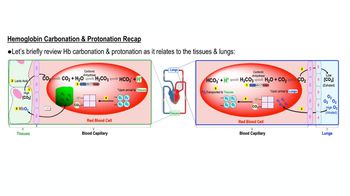
    Both hemoglobin carbonation and protonation occur in tissues, while decarbonation and deprotonation occur in the lungs.
  • What is released during the formation of carbaminohemoglobin?

    A proton (H+) is released during the formation of carbaminohemoglobin.
  • How does high CO2 partial pressure in tissues affect hemoglobin?

    High CO2 partial pressure in tissues causes hemoglobin to bind CO2, stabilizing the T state and releasing oxygen.
  • What happens to hemoglobin when it releases H+ and CO2 in the lungs?

    When hemoglobin releases H+ and CO2 in the lungs, it binds oxygen and is present in its R state.