Back

Glucose and Glycogen Regulation Practice 2 quiz

Control buttons has been changed to "navigation" mode.
1/15
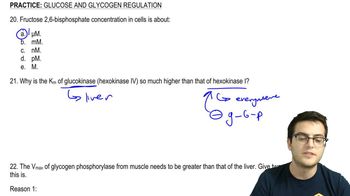
  • At what concentration is fructose 2,6-bisphosphate effective in activating phosphofructokinase 1?

    Fructose 2,6-bisphosphate is effective at activating phosphofructokinase 1 at 1 micromolar concentration.
  • Where is glucokinase found in the body?

    Glucokinase is found only in the liver.
  • What is the primary role of the liver regarding glucose?

    The liver is responsible for blood glucose management and gluconeogenesis.
  • What happens to hexokinase activity when glucose 6-phosphate levels are high?

    Hexokinase is inhibited by glucose 6-phosphate, creating a negative feedback mechanism.
  • Does glucokinase get inhibited by glucose 6-phosphate?

    No, glucokinase continues to produce glucose 6-phosphate regardless of its concentration.
  • How does the Km of glucokinase compare to that of hexokinase?

    Glucokinase has a higher Km than hexokinase.
  • What does a higher Km for glucokinase mean in terms of reaction velocity?

    A higher Km allows glucokinase to work faster at higher glucose concentrations compared to hexokinase.
  • What determines the reaction rate of glucokinase in the liver?

    The supply of glucose determines the reaction rate of glucokinase.
  • What determines the reaction rate of hexokinase?

    The demand for glucose determines the reaction rate of hexokinase.
  • Why does the liver need to take in as much glucose as possible?

    The liver needs to take in as much glucose as possible to maintain blood sugar levels.
  • Which tissue has a higher Vmax for glycogen phosphorylase: muscle or liver?

    Muscle glycogen phosphorylase has a higher Vmax than liver glycogen phosphorylase.
  • Why does muscle glycogen phosphorylase have a higher Vmax?

    Muscles need to rapidly mobilize glycogen to support quick energy needs during intense activity.
  • Why does liver glycogen phosphorylase have a lower Vmax?

    The liver needs to maintain blood glucose levels more tightly regulated, so a lower Vmax helps control glucose release.
  • What is the main function of muscle glycogen phosphorylase during fight or flight situations?

    It mobilizes glycogen quickly to support rapid muscle contraction.
  • How does the liver regulate glucose release compared to muscle?

    The liver releases glucose more carefully and slowly, while muscle releases it rapidly for immediate energy.