Skip to main content
Biochemistry
My Course
Learn
Exam Prep
AI Tutor
Study Guides
Flashcards
Explore
Try the app
My Course
Learn
Exam Prep
AI Tutor
Study Guides
Flashcards
Explore
Try the app
Back
Essential Amino Acids definitions
You can tap to flip the card.
Essential Amino Acids
You can tap to flip the card.
👆
Essential Amino Acids
Cannot be produced by the organism and must be obtained from dietary sources for proper protein function.
Track progress
Control buttons has been changed to "navigation" mode.
1/14
Related flashcards
Related practice
Recommended videos
Essential Amino Acids quiz #1
Essential Amino Acids
40 Terms
Essential Amino Acids quiz #2
Essential Amino Acids
10 Terms
Essential Amino Acids
3. Amino Acids
7 problems
Topic
Nonpolar Amino Acids
3. Amino Acids
7 problems
Topic
3. Amino Acids - Part 1 of 3
5 topics
15 problems
Chapter
3. Amino Acids - Part 2 of 3
5 topics
14 problems
Chapter
3. Amino Acids - Part 3 of 3
7 topics
16 problems
Chapter
Guided course
05:46
Memorizing Essential Amino Acids
7
views
Terms in this set (14)
Hide definitions
Essential Amino Acids
Cannot be produced by the organism and must be obtained from dietary sources for proper protein function.
Nonessential Amino Acids
Can be synthesized by the organism, so dietary intake is not required for these protein building blocks.
Tryptophan
One of the nine amino acids humans must acquire from food, often remembered using mnemonics.
Threonine
A dietary amino acid necessary for protein synthesis, included in essential lists and mnemonics.
Valine
A branched-chain amino acid that must be consumed, featured in memorization aids for essentials.
Histidine
Required in the diet for humans, sometimes highlighted in mnemonic devices for essential amino acids.
Isoleucine
A vital amino acid for humans, not synthesized internally, often grouped with other essentials.
Phenylalanine
An aromatic amino acid that must be obtained from food, commonly confused with proline in mnemonics.
Methionine
A sulfur-containing amino acid, essential for humans, and part of mnemonic phrases for memorization.
Leucine
A branched-chain amino acid, required in the diet, often paired with lysine in mnemonic strategies.
Lysine
A basic amino acid, essential for humans, included in mnemonic lists for dietary requirements.
Arginine
Sometimes considered essential due to limited synthesis and breakdown, may need dietary intake.
Protein Synthesis
The process requiring all amino acids, with essentials supplied by diet, to build functional proteins.
Mnemonic
A memory aid, such as creative phrases, used to recall the list of essential amino acids efficiently.
 BackBack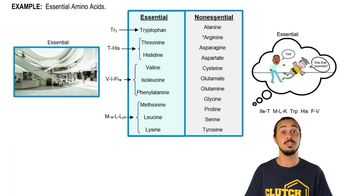
 05:46
05:46