Back

Electrostatic and Metal Ion Catalysis quiz

Control buttons has been changed to "navigation" mode.
1/15
  • What is the main function of electrostatic catalysis in enzyme reactions?

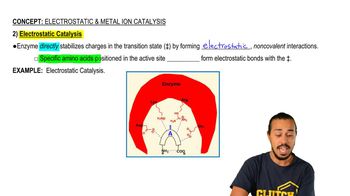
    Electrostatic catalysis stabilizes the transition state by forming direct electrostatic interactions between charged amino acids in the enzyme and the substrate, speeding up the reaction.
  • Which amino acids commonly participate in electrostatic catalysis?

    Amino acids like aspartate, lysine, arginine, and glutamate often participate due to their charged side chains.
  • How do enzymes position amino acids for electrostatic catalysis?

    Enzymes position specific charged amino acids in the active site to directly interact with and stabilize the transition state.
  • What is the effect of stabilizing the transition state in a reaction?

    Stabilizing the transition state lowers the activation energy, allowing the reaction to proceed faster.
  • How does metal ion catalysis differ from electrostatic catalysis?

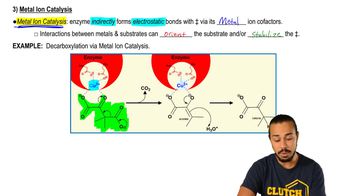
    In metal ion catalysis, the enzyme uses a metal ion cofactor to indirectly stabilize the substrate, whereas in electrostatic catalysis, the enzyme's amino acids directly interact with the substrate.
  • What role do metal ion cofactors play in metal ion catalysis?

    Metal ion cofactors, such as copper, stabilize negative charges on the substrate, facilitating the reaction.
  • In the example given, which metal ion is used as a cofactor for catalysis?

    Copper is used as the metal ion cofactor in the example.
  • What is the substrate undergoing in the metal ion catalysis example?

    The substrate undergoes decarboxylation, losing a CO2 group and forming an enolate intermediate.
  • How does the copper ion stabilize the substrate during the reaction?

    The copper ion forms electrostatic interactions with the negatively charged oxygen atoms on the substrate.
  • What is the final product formed after the reaction in the metal ion catalysis example?

    The final product is a ketone, which has a carbonyl group with two R groups attached.
  • Why are electrostatic interactions important in enzyme catalysis?

    Electrostatic interactions help stabilize charged intermediates or transition states, making reactions proceed more efficiently.
  • What is the main takeaway about the difference between electrostatic and metal ion catalysis?

    Electrostatic catalysis involves direct enzyme-substrate interactions, while metal ion catalysis involves indirect stabilization via a metal ion cofactor.
  • How do enzymes use metal ions to orient substrates?

    Metal ions can help orient substrates in the active site, positioning them for optimal reaction and stabilization.
  • What happens to the negative charges on the substrate during metal ion catalysis?

    Negative charges are stabilized by the metal ion, reducing instability and facilitating the reaction.
  • What is the overall benefit of both electrostatic and metal ion catalysis for metabolic processes?

    Both mechanisms increase catalytic efficiency by stabilizing transition states or intermediates, which is essential for fast and regulated metabolic reactions.