Back

Determining Net Charge of a Peptide definitions

Control buttons has been changed to "navigation" mode.
1/15
  • Peptide

    A chain of amino acid residues linked by peptide bonds, possessing ionizable groups that contribute to its overall charge.
  • Net Charge

    The sum of all positive and negative charges from ionizable groups within a peptide at a specific pH.
  • Ionizable Group

    A functional group within a peptide that can gain or lose protons, affecting the molecule's charge depending on pH.
  • pKa

    A value indicating the pH at which an ionizable group is half dissociated, crucial for predicting charge states.
  • pH

    A measure of hydrogen ion concentration in solution, determining the ionization state of peptide groups.
  • Amino Acid Residue

    An individual amino acid unit within a peptide chain, often with distinct ionizable properties compared to free amino acids.
  • Alpha Amino Group

    The free amino group at the N-terminus of a peptide, capable of carrying a positive charge depending on pH and pKa.
  • Alpha Carboxyl Group

    The free carboxyl group at the C-terminus of a peptide, typically contributing a negative charge at physiological pH.
  • N-Terminus

    The starting end of a peptide chain, featuring a free alpha amino group that can be ionized.
  • C-Terminus

    The ending end of a peptide chain, featuring a free alpha carboxyl group that can be ionized.
  • Microenvironment

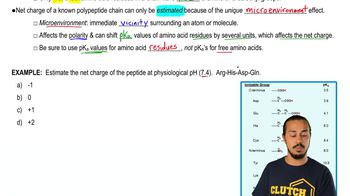
    The immediate surroundings of a peptide or protein, capable of altering pKa values and thus affecting net charge.
  • Conjugate Acid

    The protonated form of an ionizable group, predominating when pKa exceeds pH and often carrying a positive charge.
  • Conjugate Base

    The deprotonated form of an ionizable group, predominating when pH exceeds pKa and often carrying a negative or neutral charge.
  • R Group

    The side chain of an amino acid residue, which may be ionizable and contribute to the peptide's net charge.
  • Physiological pH

    A typical biological pH value, around 7.4, used as a reference for determining peptide charge states.