Back

Citric Acid Cycle Practice 1 quiz

Control buttons has been changed to "navigation" mode.
1/15
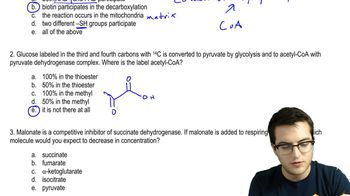
  • Which cofactor does NOT participate in the pyruvate dehydrogenase complex?

    Biotin does not participate; the complex uses TPP, lipoate, and FAD.
  • Where in the cell does the pyruvate dehydrogenase complex operate?

    It operates in the mitochondrial matrix.
  • What are the two thiol-containing molecules involved in the pyruvate dehydrogenase complex?

    TPP and CoA both contain thiol groups.
  • Which two electron carriers are involved in the pyruvate dehydrogenase complex reactions?

    NAD and FAD are both involved; NAD is reduced to NADH, and FAD is used in the process.
  • What happens to carbons 3 and 4 of glucose during glycolysis and conversion to acetyl CoA?

    Carbons 3 and 4 are lost as CO2 during these processes.
  • If glucose is labeled at carbons 3 and 4 with C14, will the label be found in acetyl CoA after glycolysis and pyruvate dehydrogenase?

    No, the label will not be found in acetyl CoA because those carbons are lost as CO2.
  • What is the effect of malonate on succinate dehydrogenase?

    Malonate competitively inhibits succinate dehydrogenase.
  • What happens to fumarate and succinate concentrations when malonate is added to mitochondria?

    Fumarate concentration decreases and succinate concentration increases.
  • Is acetyl CoA considered an intermediate of the citric acid cycle?

    No, acetyl CoA is a substrate that enters the cycle but is not an intermediate.
  • Name three intermediates of the citric acid cycle.

    Citrate, isocitrate, and oxaloacetate are intermediates.
  • What happens to uniformly C14-labeled oxaloacetate after one turn of the citric acid cycle with unlabeled acetyl CoA?

    Half of the radioactive label (50%) remains in oxaloacetate after one cycle.
  • How many carbons does oxaloacetate have?

    Oxaloacetate has four carbons.
  • During the citric acid cycle, how many carbons are lost as CO2 per turn?

    Two carbons are lost as CO2 per turn.
  • Why can't we specify which two carbons remain labeled in oxaloacetate after one cycle?

    Because of randomization of succinate's orientation, we can't specify which two carbons remain labeled.
  • Which molecule combines with acetyl CoA to form citrate in the citric acid cycle?

    Oxaloacetate combines with acetyl CoA to form citrate.