Back

Citric Acid Cycle 4 quiz

Control buttons has been changed to "navigation" mode.
1/15
  • What enzyme converts fumarate to L-malate in the citric acid cycle?

    Fumarase converts fumarate to L-malate by adding water across the double bond.
  • What is the product of the reaction catalyzed by malate dehydrogenase?

    Malate dehydrogenase converts malate to oxaloacetate, producing NADH.
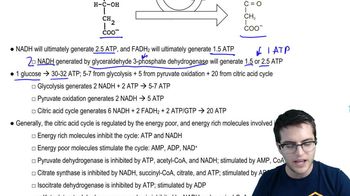
  • How many ATP are generated from one NADH during oxidative phosphorylation?

    One NADH generates 2.5 ATP during oxidative phosphorylation.
  • How many ATP are generated from one FADH2 during oxidative phosphorylation?

    One FADH2 generates 1.5 ATP during oxidative phosphorylation.
  • Why is there a difference in ATP yield between NADH and FADH2?

    The difference is due to their different entry points in the electron transport chain, affecting how much ATP is produced.
  • What is the total ATP yield from one molecule of glucose under aerobic conditions?

    One glucose molecule yields 30 to 32 ATP, depending on the pathway taken by NADH from glycolysis.
  • How many ATP are produced from glycolysis per glucose molecule?

    Glycolysis produces 5 to 7 ATP per glucose, depending on the fate of NADH.
  • How many ATP are produced from pyruvate oxidation per glucose molecule?

    Pyruvate oxidation produces 5 ATP per glucose molecule.
  • How many ATP are produced from the citric acid cycle per glucose molecule?

    The citric acid cycle produces 20 ATP per glucose molecule.
  • Which molecules inhibit key enzymes of the citric acid cycle?

    Energy-rich molecules like ATP and NADH inhibit key enzymes of the citric acid cycle.
  • Which molecules stimulate key enzymes of the citric acid cycle?

    Energy-poor molecules like ADP and NAD+ stimulate key enzymes of the citric acid cycle.
  • Name two enzymes of the citric acid cycle that are regulated by their products.

    Citrate synthase and alpha-ketoglutarate dehydrogenase are regulated by their products and downstream molecules.
  • What is the role of anaplerotic reactions in the citric acid cycle?

    Anaplerotic reactions generate oxaloacetate to replace molecules lost from the citric acid cycle, ensuring its continuous operation.
  • Which reactions of the citric acid cycle are reversible and allow regeneration of intermediates?

    Reactions 5, 6, 7, and 8 are reversible, allowing regeneration of intermediates like malate, fumarate, and succinyl CoA.
  • Why can't the reaction producing succinyl CoA be reversed in the citric acid cycle?

    The reaction producing succinyl CoA is irreversible because it is one of the cycle's key regulatory steps.